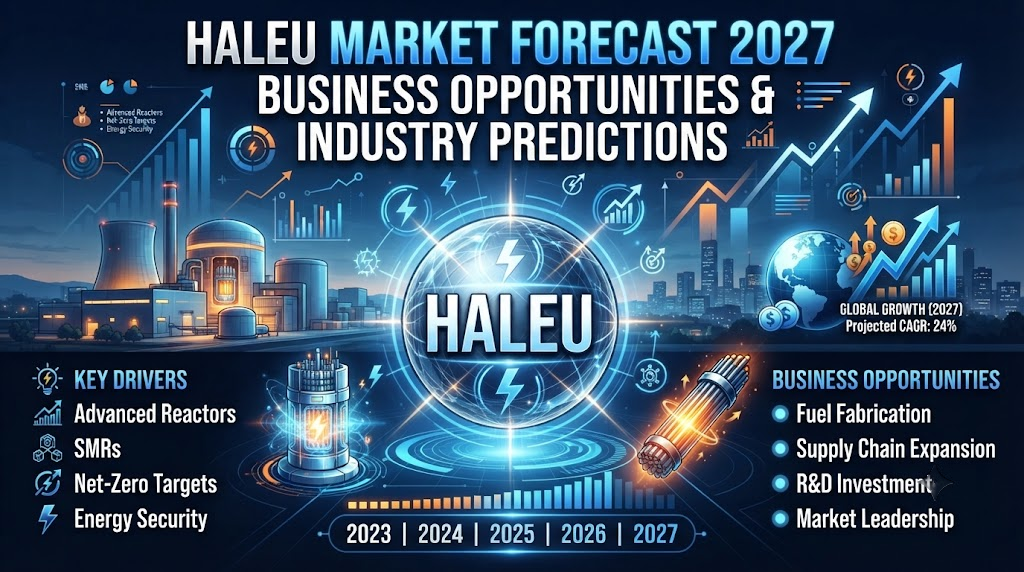
The HALEU story has quietly shifted from a technical milestone to an investment thesis. For most of the past decade, high-assay low-enriched uranium was discussed as an enabling technology, something advanced reactors would need eventually. That framing is now outdated. With the Department of Energy moving from demonstration funding into a commercial-scale contract with Centrus Energy, and with billions of dollars of government capital now committed to closing the Western supply gap, HALEU has entered the phase where it needs to be evaluated the way any capital-intensive, supply-constrained commodity market is evaluated. This article sets out where the business and investment opportunity is heading through 2027 and how executives should be positioning against it.
Why 2027 is the pivot year, not the arrival year
It is important to be precise about what 2027 actually represents. It is not the year HALEU becomes abundant. New commercial-scale enrichment capacity from the leading Western players is not expected online until 2029 at the earliest, and competing suppliers are tracking even later. What 2027 represents instead is the pivot point where HALEU stops being a subsidised demonstration product and starts behaving like a real, if still tight, commercial market. Contracts signed this year will define pricing benchmarks, offtake structures, and security protocols for the rest of the decade. Companies that treat 2027 as a waiting period will find themselves negotiating from a weaker position in 2029 and beyond. Companies that treat it as the year to lock in supply agreements, equity positions, or long-term offtake commitments will be negotiating from strength.
This is a familiar pattern in commodity markets that transition from government-subsidised development to private capital formation. The early movers who commit capital during the scarcity phase, before supply fully catches up to demand, tend to capture disproportionate value once the market matures. HALEU is following that arc closely.
The investment case rests on a structural, not cyclical, shortage
The most important thing for investors and business leaders to understand is that the current HALEU shortage is not a temporary supply hiccup. It is structural, and it will persist for years. The reason is straightforward: enrichment capacity cannot be built quickly. It requires long licensing timelines, large capital outlays, and specialised centrifuge technology that only a handful of companies in the world can deploy at scale. Even with strong government backing, the build-out timeline for new capacity is measured in years, not quarters.
This matters for how investors should think about the sector. A structural shortage with a multi-year resolution timeline is a very different opportunity than a cyclical shortage caused by a temporary disruption. Cyclical shortages get arbitraged away quickly once new supply comes online. Structural shortages reward patient capital that positions early and holds through the build-out period. For a nuclear-focused investor or a strategic acquirer, this means the 2026 to 2029 window is the period to build positions, not the period to wait on the sidelines for prices to normalise.
Government capital is de-risking the entry point, but not forever
One of the most useful signals for business planning is how government money is being deployed. Rather than funding research indefinitely, the Department of Energy has moved decisively toward commercial contract structures, fixed-price awards tied to actual production milestones, with purchase options attached. This is a strong signal that government sees HALEU as past the R&D stage and ready for commercial discipline.
For companies in the sector, this creates a narrowing window of low-risk entry. Early government contracts effectively underwrite the capital risk of building enrichment capacity, which is why the companies securing those contracts now are locking in a durable advantage. As the market matures and government’s role shifts from primary funder to buyer of last resort, later entrants will face a less generous risk-sharing environment. Businesses evaluating whether to enter HALEU-adjacent markets, whether in enrichment, fuel fabrication, transport, or fuel cycle services, should treat the next 18 to 24 months as the most favourable period for negotiating government-backed risk mitigation. After that, the terms available to new entrants are likely to tighten as the market normalises and government support becomes more selective.
Where the forecast points for reactor developers and utilities
For SMR developers and utilities planning reactor deployments, the forecast implication is direct: fuel supply certainty, not reactor design maturity, is likely to be the binding constraint on deployment schedules through the end of the decade. A reactor design can be finished and licensed, but if the fuel cycle behind it cannot deliver HALEU on a predictable schedule, the project timeline slips regardless of engineering progress.
This changes the calculus for how reactor developers should approach 2027. Companies that secure long-term fuel supply agreements now, even at a premium, are effectively buying schedule certainty for their entire deployment pipeline. Companies that delay those agreements are taking on a form of hidden project risk that is easy to underweight during design and licensing phases but becomes very visible once construction schedules are set. Boards and investors evaluating SMR developers should treat the strength and specificity of a company’s fuel supply arrangements as a leading indicator of deployment credibility, arguably as important as the regulatory approval timeline itself.
The competitive landscape will bifurcate
Looking ahead, the HALEU supply landscape through 2027 is likely to bifurcate into two tiers. The first tier consists of companies with active government contracts, operating capacity, and a demonstrated production track record. These companies will have pricing power and the ability to be selective about customers, because near-term supply will remain scarce relative to the number of reactor developers seeking it. The second tier consists of companies still in the licensing, financing, or construction phase, whose product will not reach the market until closer to 2029 or 2030. These companies will need to compete primarily on future capacity commitments and price, since they cannot yet compete on delivery.
For investors, this bifurcation suggests a barbell strategy: capital deployed toward first-tier producers captures near-term cash flow and pricing power, while capital deployed toward well-positioned second-tier entrants captures long-term upside if the broader advanced reactor market grows as expected. Straddling both tiers, rather than betting exclusively on one, is likely to be the more resilient investment posture given how much reactor deployment timelines can still shift.
What this means for strategic planning in 2027
Bringing this together, the practical forecast for business leaders is this. Treat 2027 as a negotiating window, not a delivery deadline. Prioritise locking in supply relationships or capital positions before government risk-sharing terms tighten. Recognise that fuel supply certainty is becoming a more important competitive differentiator for reactor developers than design or licensing progress alone. And expect the supplier landscape to separate clearly into producers with near-term leverage and developers competing on future promises, a split that will shape partnership and investment decisions well beyond 2027 itself.
The companies and investors who move decisively in this window are positioning themselves for the structural growth phase of the advanced reactor industry, rather than waiting to react to it once the fuel supply constraint has already been resolved.
Access the Global HALEU Supply Chain Brief here: