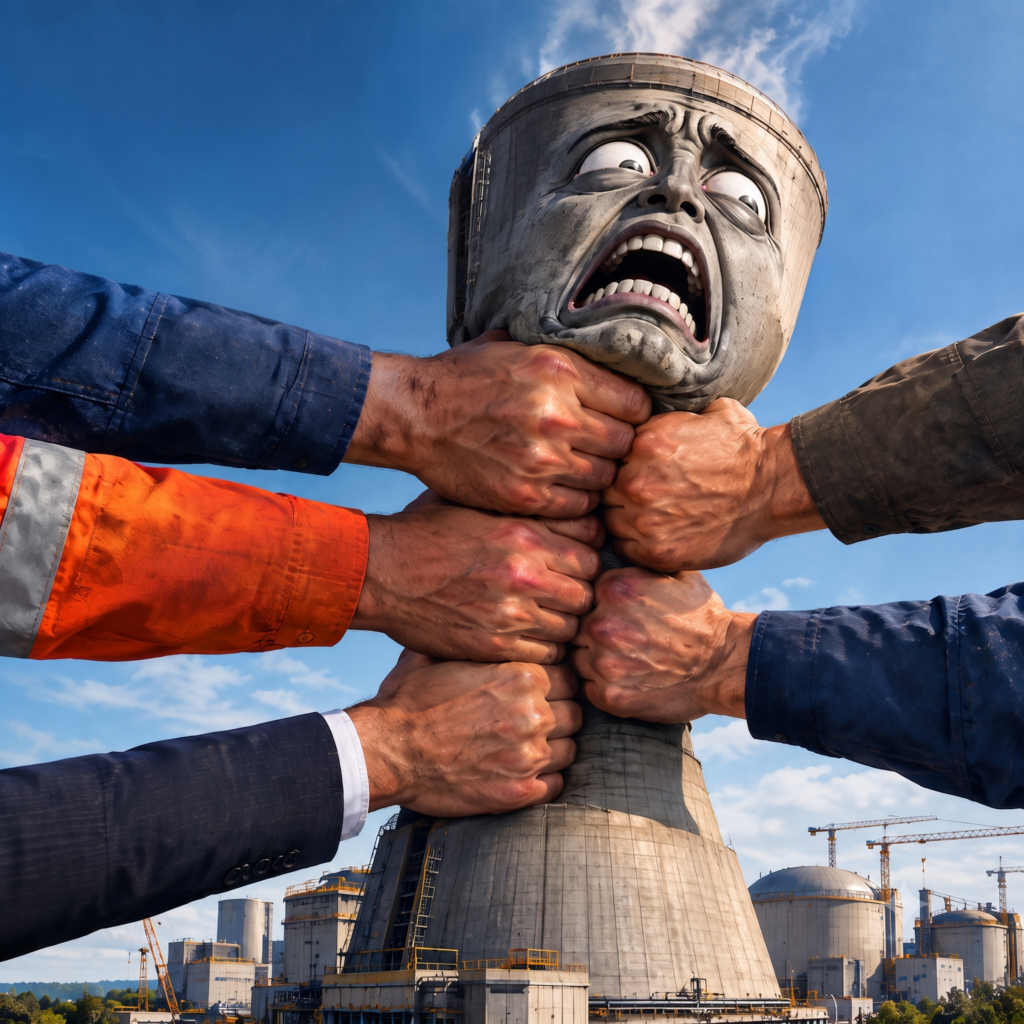
Government targets for hundreds of gigawatts of new nuclear capacity by 2050 are not constrained by demand or policy. They are constrained by physical industrial capacity. The global supply chain is configured for fleet preservation, not rapid expansion. Four bottlenecks are critical: heavy forging, HALEU enrichment, specialized components, and certified labor.
1. Heavy Forging: Oligopoly and Attrition
Generation III+ reactors and several SMR designs require single-piece forged reactor pressure vessels (RPVs) and steam generator shells. This eliminates weld seams and reduces inspection and embrittlement risks over 60-year lifetimes.
Production requires hydraulic presses of 10,000 to 17,000 tonnes and monobloc ingots of 500 to 700 tonnes. Qualified capacity is concentrated in Asia.
| Country | Primary Fabricator | Press Capacity (Tonnes) | Max Ingot (Tonnes) | Annual RPV Sets |
|---|---|---|---|---|
| Japan | Japan Steel Works | 14,000 | 650 | ~12 |
| France | Framatome | 9,000 | 500 | Constrained by audits |
| UK | Sheffield Forgemasters | 10,000 | 300 | Captive (naval/domestic) |
| South Korea | Doosan Enerbility | 15,000 | 500 | 10+ (domestic captive) |
Raw press tonnage is a visible constraint but not the primary bottleneck. Downstream operations are the true critical path. Once forged, components require multi-year cycles of high-tolerance machining, specialized cladding, and rigorous quality inspection. Manufacturing throughput is limited by the sharp attrition of certified suppliers holding ASME Section III “N-stamp” accreditation since their 1980s peak. The stringent documentation and audit demands of the ASME NQA-1 nuclear quality assurance standard impose severe overhead. This creates high entry barriers for commercial manufacturers absent guaranteed, multi-unit procurement contracts.
2. HALEU: Single-Source Dependency
Advanced Generation IV reactors and over half of developing SMR designs require High-Assay Low-Enriched Uranium (HALEU), enriched to between 5% and 20% Uranium-235. HALEU enables compact core configurations, higher fuel burnup, and longer intervals between refuelings.
Commercial-scale production remains absent in Western nations. Historically, Tenex, a subsidiary of Russia’s state-owned Rosatom, served as the sole global commercial supplier of HALEU. The United States enacted the Prohibiting Russian Uranium Imports Act in May 2024, banning Russian low-enriched uranium through 2040. While the law contains waiver mechanisms through January 2028, this geopolitical severance created a structural fuel deficit before domestic or allied enrichment alternatives could reach industrial scale.
| Segment | Status | Demand (Late 2020s) | Constraint |
|---|---|---|---|
| Commercial LEU (<5%) | Urenco, Orano, Rosatom | ~2,000 MTU (U.S. domestic) | U.S. relies on imports for ~24% of enrichment; domestic covers 30 to 35% |
| Commercial HALEU (5 to 20%) | Russia (Tenex), China | >40 MTU/year (U.S. demos) | Western production zero; Russian supply restricted by statutory bans |
| Allied Scale-Up | Centrus (U.S.), Urenco (UK/US) | Demo to early commercial | Centrus delivered ~920 kg (2023 to 2025); gated by capital and 5B cylinder shortages |
Centrus Energy operates the only licensed demonstration cascade in the United States, yielding roughly 920 kilograms between late 2023 and mid-2025. This pace is insufficient against projected Department of Energy requirements exceeding 40 metric tons by the late 2020s. The constraint extends into physical logistics. Category II transport requires specialized Type 5B cylinders, which are in extreme shortage, creating transport bottlenecks for completed fuel.
3. Specialized Components and Equipment Gating
Beyond large pressure vessels, reactors depend on precision systems engineered for high-radiation, high-temperature, and corrosive operating environments. Tier-1 and Tier-2 systems, including Control Rod Drive Mechanisms (CRDMs), primary coolant pumps, and nuclear-class isolation valves, rely on scarce nickel-based superalloys such as Inconel and precise electrical integration. Component lead times typically span four to seven years, exposing capital outlays to commodity price volatility and engineering revisions.
Construction logistics face parallel equipment chokepoints. Deploying modular reactor sections and installing monolithic RPVs require heavy-lift cranes with capacities exceeding 500 tonnes, ring cranes, and self-propelled modular transporters (SPMTs). These heavy-lift assets have forward-booking windows of two to five years and are heavily contested by offshore wind fabrication, large aerospace assembly, and petrochemical expansions.
4. Skilled Workforce: Demographic Deficit
The civilian nuclear sector faces a critical demographic imbalance. Industry surveys from the Nuclear Energy Institute indicated that nearly 40% of the nuclear workforce was eligible for retirement within the past decade. This retirement cycle has created significant talent deficits across both specialized engineering disciplines and certified craft labor.
On-site execution risk is acutely visible in safety-critical trade roles. Manual and orbital pipe welders must hold certifications under ASME Section IX and Section III Subsection NB, maintaining complete structural integrity verified via radiography and phased-array ultrasonic testing. Similar deficits persist among Level III NDE technicians and nuclear quality assurance auditors.
These workforce constraints directly undermine EPC performance. Recent builds in the West demonstrate how unvetted subcontractors, incomplete initial engineering designs, and recurring documentation flaws cause massive delays. Flamanville 3 in France incurred a 17-year construction period. Vogtle Units 3 and 4 in the United States followed a similar pattern. In nuclear construction, schedule delays are financially devastating. Compound Interest During Construction (IDC) accumulates rapidly, historically accounting for over 40% of the total capital cost of delayed nuclear plants.
5. Non-Linear Fleet Scaling Dynamics
A fundamental analytical flaw in nuclear expansion targets is the presumption of linear scalability. Transitioning from building a handful of first-of-a-kind prototypes to simultaneous multi-unit fleet rollouts transforms isolated supply frictions into systemic gridlock.
| Dimension | Isolated Project (1 to 3 Units) | Fleet Deployment (Dozens of Units) |
|---|---|---|
| Heavy Forging | Queue priority managed via bespoke premium contracts | Simultaneous capacity conflicts across all allied forging presses |
| Front-End Fuel Supply | Demonstration needs met by government downblending | Immediate exhaustion of Western LEU and HALEU enrichment capacity |
| Certified Craft Labor | Ad-hoc pooling of mobile, certified NQA-1 welders | Acute cross-project craft poaching, schedule slippage, and wage spikes |
| Heavy-Lift Tooling | Temporary leasing gaps tolerated within flexible windows | Direct resource competition for ring cranes and SPMT fleets |
| Industrial Learning Curve | Diluted by custom requirements for each build | Standardized repetition required to capture positive cost learning |
In a bespoke deployment model, supply deficits are mitigated through custom project concessions, spot-market premiums, and regulatory accommodations. When dozens of reactors are ordered concurrently, these mitigation strategies break down. Independent procurement efforts simultaneously draw on the same few heavy presses, the single domestic HALEU cascade, and a shallow pool of certified craft labor.
This strain is exacerbated by extreme design fragmentation. With more than 60 to 90 competing SMR and advanced reactor concepts under development globally, suppliers face disparate, non-standardized material specifications, coolant environments, and fuel designs. This fragmentation prevents the capital pooling and standardized manufacturing lines essential for amortizing fixed qualification costs.
Strategic Outlook
The nuclear renaissance cannot progress on paper designs and executive mandates alone. Reaching projected deployment goals requires resolving upstream industrial choke points.
Capital commitments must be directed toward commercializing Western HALEU enrichment, underwriting ASME Section III manufacturing investments through programmatic order aggregation, standardizing reactor designs to eliminate qualification redundancies, and expanding vocational pipelines for certified nuclear craft labor.
Until capital investment directly resolves these foundational supply-chain deficits, new nuclear capacity additions will remain constrained by physical industrial limits.
Subscribe to NIB for more insights