The global Micro Modular Reactor market is completing a structural transition. After years of research programs, design certification, and government-subsidized demonstrations, commercial deployment is now underway. The 2027-2034 MMR Market Intelligence Report from Nuclear Intelligence Brief projects the market will compound at 15.2% annually, reaching $6.90 billion by 2034.
The significance of this forecast lies not in the headline number but in what is driving the growth. Three demand shocks are converging simultaneously: acute baseload power shortages across hyperscale AI infrastructure, severe fuel-cost volatility in remote resource extraction, and hardening industrial decarbonization mandates. Each creates a distinct commercial case for MMR deployment.
A New Commercial Framework
The single most important development in the MMR market is not a reactor design breakthrough. It is the adoption of the Build-Own-Operate model paired with long-term Power Purchase Agreements.
Under this structure, the reactor developer or a project-specific Special Purpose Vehicle licenses, builds, owns, and operates the plant. The customer signs a 20- to 40-year contract to purchase electricity and thermal energy at a structured tariff. Nuclear power procurement becomes an operating expense. The enterprise buyer no longer needs to finance construction, manage licensing, or assume operational risk.
This framework addresses the balance-sheet objection that stalled previous nuclear commercialization cycles. A single MMR module generating 1 to 15 megawatts requires approximately $20 to $100 million in capital outlay. That figure sits within the underwriting capacity of private capital, venture funds, corporate balance sheets, and standard project-finance vehicles. The contrast with gigawatt-scale nuclear is not a criticism of that technology. It is a recognition that different capital structures serve different markets.
The Economics Are Clear for Specific Applications
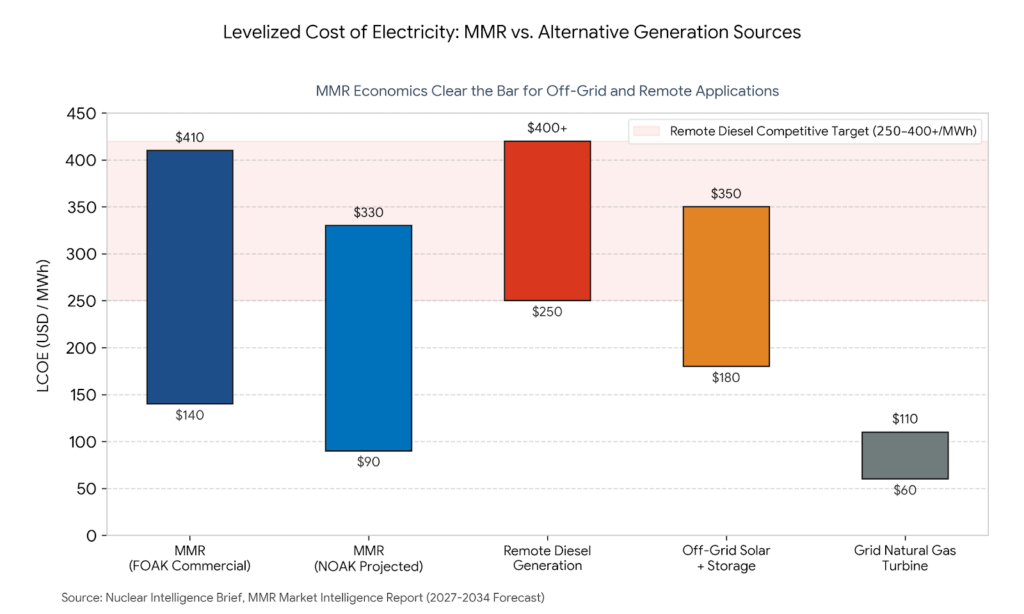
The levelized cost of electricity for FOAK commercial microreactors spans $140 to $410 per megawatt-hour. As factory serial production matures, NOAK units are projected to reach $90 to $330 per megawatt-hour. These figures are above bulk grid wholesale power in most urban markets. That is not where MMRs compete.
The addressable economic case is off-grid and behind-the-meter. Against remote diesel generation at $250 to $400 or more per megawatt-hour, and off-grid solar-plus-storage at $180 to $350 per megawatt-hour, the economics already work. The report identifies three applications where this is the case: remote off-grid industrial operations, high-temperature industrial process heat, and speed-to-power applications where grid interconnection is unavailable.
This is a narrower addressable market than all electricity demand, but it is a real and monetizable one. It forms the foundation for the $6.90 billion forecast.
The Market Is Rotating Toward Industrial Buyers
The segmentation data reveals a structural shift. Utilities and Independent Power Producers currently hold the largest share at 39.4%, generating $709 million in 2025. Their growth is the slowest among buyer categories, compounding at 14.8%. Industrial and Heavy Manufacturing is forecast to become the single largest end-user segment by 2034, reaching $2.80 billion.
This transition matters. Industrial buyers purchase on different criteria than utilities. They are driven by total delivered cost of energy versus their diesel baseline, adjusted for fuel-logistics volatility and carbon exposure. They also face harder commercial mandates and faster decision cycles than regulated utilities. The BOO/PPA model is particularly well-suited to their procurement processes because it converts nuclear energy into a predictable operating expense.
Hyperscale data center operators represent the fastest-growing demand driver, expanding at a 15.6% compound annual growth rate from $275 million in 2025 to over $1.10 billion by 2034. Their primary purchasing criterion is speed-to-power. Multi-year grid interconnection queues make grid power unavailable on their required timeline. This is a temporary market condition, but it has created an anchor customer base that is absorbing FOAK execution risk for reactor vendors.

The Fuel Supply Bottleneck
A central operational constraint for advanced non-light-water microreactors is High-Assay Low-Enriched Uranium (HALEU), enriched between 5% and 19.75% Uranium-235. Commercial HALEU enrichment capacity was historically concentrated in Russia, presenting a geopolitical supply chain risk.
The U.S. Department of Energy finalized $2.70 billion in domestic fuel enrichment awards in January 2026, allocating capital to Centrus Energy, Orano, and Urenco to establish Western commercial enrichment infrastructure. While this addresses the geopolitical dependency, fuel fabrication throughput will remain a tight operational constraint through 2027.
This gives light-water reactor designs a structural fuel-access advantage over HTGR, liquid-metal, and molten-salt competitors through 2027-2028. The implication is not that one architecture is superior to another. It is that fuel availability will determine which designs reach commercial deployment first, independent of their relative technical merit.
Regulatory Timeline Risk
Navigating nuclear regulatory approval remains a critical execution factor. While regulatory alignment is advancing through joint technical review frameworks between the U.S. NRC and Canadian CNSC, potential design modifications required during environmental and site reviews remain the primary schedule risk for FOAK projects.
Unlike fuel supply, which is at least partially addressable through capital deployment, regulatory timeline risk is largely outside any individual developer’s control. The report identifies this as the least forecastable and most consistently underestimated risk category. A regulatory delay extends the period over which a developer must fund operations without revenue. This in turn increases capital risk. A capital shortfall can force a developer to delay fuel procurement commitments, increasing supply chain risk. The three risk categories compound rather than operate independently.
The USNC Precedent
Ultra Safe Nuclear Corporation filed for Chapter 11 bankruptcy in October 2024. Despite securing government research grants and establishing agency partnerships, the company recorded $81.20 million in operating expenses against just $6.15 million in revenue in 2023. Without an anchor investor to finance its planned 2026 fuel factory, it filed for protection. Its assets were sold off in 2025.
This bankruptcy is the clearest historical illustration of the compounding dynamic between capital, regulatory, and supply chain risks. Technical credibility and government relationships were insufficient without anchor-investor-backed liquidity and a genuinely committed off-taker base. The report expects similar failures among under-capitalized developers through 2027-2028.
The Investment Framework
For institutional investors, the report provides a clear screening framework. Evaluate developers on four criteria: balance sheet liquidity of $1 billion or more, a dual-country regulatory strategy, secured Western HALEU access, and binding PPA commitments rather than non-binding letters of intent.
Valuation discipline matters. Any developer’s growth narrative claiming materially faster expansion than the sector’s 15.2% CAGR should be benchmarked against that baseline and explained relative to specific advantages in backlog conversion, cost compression, or market share capture.
Capital formation trends to watch include additional public listings, SPV-level infrastructure financing, strategic corporate equity from hyperscale firms, and distressed-asset consolidation. The report recommends diversified exposure across the value chain rather than concentrated single-developer positions.
The Outlook
The 2027-2034 forecast shows the MMR market compounding at approximately 15.2% annually to $6.90 billion in the base case. The more consequential story is structural. The market is rotating from utility-led to industrial-led demand, from electricity sales to thermal-energy applications, and from direct-purchase to BOO/PPA transaction structures.
Vendors that align standardized factory production, secured fuel supply lines, and low-friction Power Purchase Agreement structures are positioned to capture leading market positions. Enterprise buyers facing multi-year grid interconnection queues or diesel costs above $250 per megawatt-hour have a clear economic case for engaging with this market in 2027. Institutional investors seeking exposure to a 15.2% CAGR infrastructure asset class have a clear screening framework for evaluating opportunities.
Three variables will determine the actual outcome: the pace of HALEU fuel fabrication throughput, the rate at which regulatory harmonization proceeds without major design-modification setbacks, and the conversion rate of non-binding commercial pipeline into binding, revenue-generating PPAs. Quarterly monitoring of these indicators will provide early signals of scenario divergence from the base case.