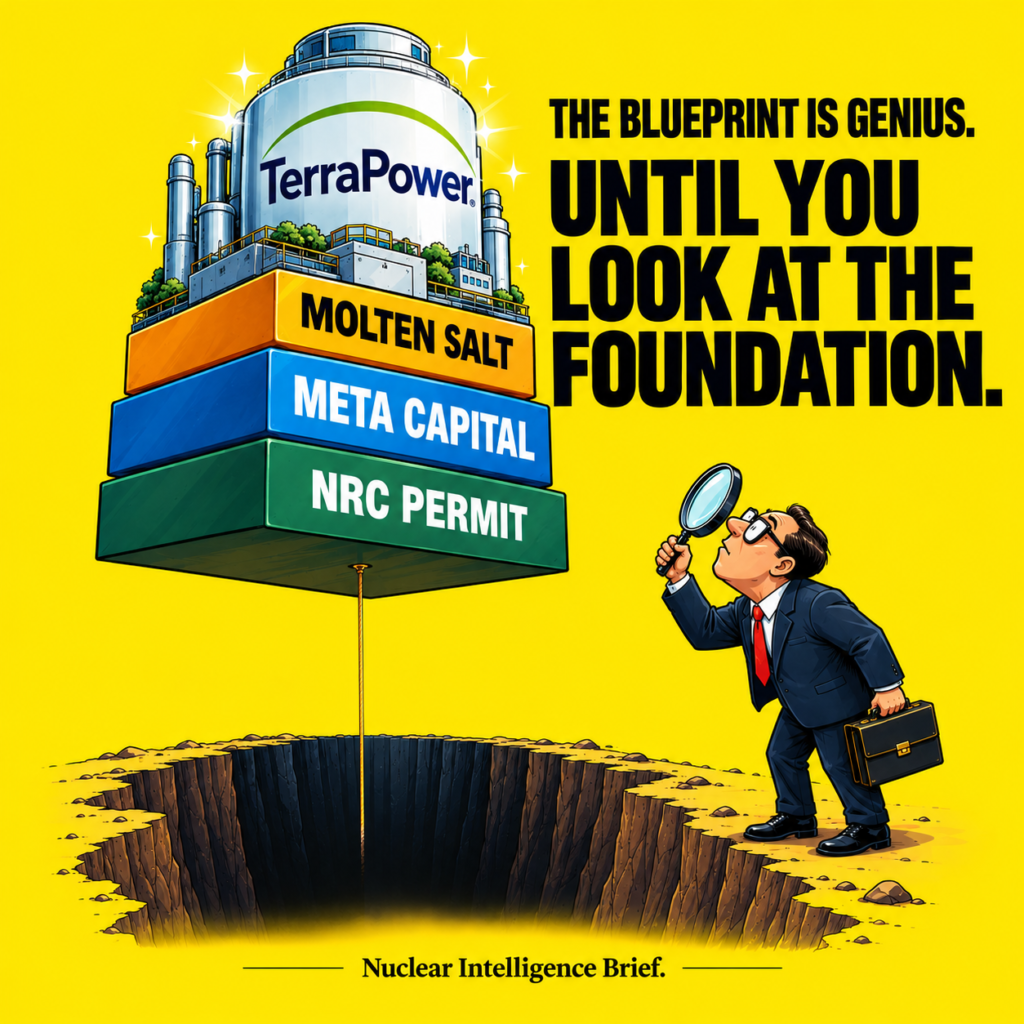
On March 4, 2026, the U.S. Nuclear Regulatory Commission unanimously granted a construction permit for TerraPower’s Kemmerer Power Station Unit 1 in Lincoln County, Wyoming. It was the first commercial non-light-water reactor authorization in over four decades, and the first commercial nuclear construction permit the NRC had issued in nearly ten years. TerraPower broke ground on April 23, 2026.
The significance is not metallurgical. It is financial. TerraPower has dismantled the traditional capital bottlenecks of nuclear energy, converting fission from an inflexible, rate-based public utility play into a high-margin, dispatchable asset class built for the hyperscale AI economy.
Regulatory Perimeter Arbitrage
Historically, utility-scale nuclear construction suffered from severe cost overruns because nuclear-grade safety standards applied indiscriminately across the entire facility, including conventional steam turbines and balance-of-plant systems.
TerraPower bypassed this failure mode by physically and legally decoupling the reactor core from the power conversion infrastructure. The 345 MWe sodium-cooled fast reactor, designated the Nuclear Island, sits apart from the power generation and energy storage facilities, designated the Energy Island. That separation established a narrow regulatory perimeter. The NRC’s safety review was confined to the reactor assembly, allowing the secondary energy island to be built under standard commercial industrial codes rather than nuclear-grade quality assurance protocols.
The result was measurable. TerraPower submitted a 14,000-page application under 10 CFR Part 50 in March 2024, secured docketing in May 2024, and completed the NRC safety and environmental evaluation in eighteen months, cutting nine months off original projections.
Hyperscale Capital Replacing Utility Rate-Bases
The traditional rate-basing model, which passes multi-billion-dollar construction costs onto retail electricity ratepayers, cannot keep pace with hyperscale computing demand.
TerraPower disrupted that bottleneck by pioneering direct corporate off-take agreements, converting technology hyperscalers into primary nuclear sponsors. On January 9, 2026, TerraPower entered a landmark commercial agreement with Meta Platforms to develop up to eight Natrium plants in the United States, supplying up to 2.8 GW of carbon-free baseload power and up to 4 GW of peak dispatchable capacity. Meta provides upfront capital for early development of an initial dual-reactor facility targeted for commercial deployment as early as 2032, with rights to off-take across six additional units.
That framework alters project finance dynamics. Tech giants possess liquid balance sheets and urgent operational timelines, enabling them to fund pre-construction activity, bypass regional transmission interconnection queues, and eliminate merchant price risk. Corporate off-take commitments, combined with a dollar-for-dollar match under the Department of Energy’s $2 billion Advanced Reactor Demonstration Program, de-risk total capital deployment for institutional co-investors. The structure attracted international equity partners including SK Group with a $250 million investment, HD Hyundai, and Korea Hydro & Nuclear Power, which joined TerraPower’s investor base in January 2026.
Peak-Load Financialization via Molten-Salt Arbitrage
Conventional nuclear plants face economic friction in modern spot markets because they must operate continuously at baseline output regardless of grid price fluctuations, often incurring negative pricing during peak renewable generation hours.
Natrium eliminates that inefficiency by integrating high-temperature molten-salt thermal energy storage directly into its power train. The reactor core operates at a continuous 345 MWe thermal baseline, maximizing fuel burnup efficiency and component longevity. During periods of low grid demand, excess thermal energy is diverted into liquid salt tanks rather than immediately converted to electricity. When spot prices spike or high-density computing workloads surge, the thermal storage boosts total electrical output to 500 MWe for over five hours without altering core operations.
For a dual-unit cluster, baseline output scales from 690 MWe of firm power to 1 GW of peak dispatchable electricity. That converts advanced nuclear generation from a rigid baseload producer into a flexible power arbitrage engine, capturing high-margin peak pricing, satisfying data center uptime guarantees, and removing reliance on natural gas peaking units.
Infrastructure Reclamation and Fuel Realignment
Site selection at Kemmerer delivers an additional layer of capital efficiency. Siting Unit 1 adjacent to a retiring 380 MW coal-fired plant allows the project to reclaim existing high-voltage transmission interconnects, industrial water rights, transportation corridors, and a skilled industrial workforce. Reusing legacy brownfield infrastructure eliminates substantial civil construction overhead while avoiding multi-year interconnection queue delays.
TerraPower has also addressed its critical fuel supply chain. Initial timelines encountered headwinds from historical reliance on Russian-sourced HALEU. Federal legislation phasing out Russian fuel imports unlocked $2.7 billion in Department of Energy funding to establish domestic enrichment infrastructure. Supported by a breakthrough in commercial uranium metallization achieved by Framatome and TerraPower in November 2025, the project has established a fuel commercialization pathway for multi-unit fleet expansion throughout the 2030s.
That pathway remains under construction. The first units depend on domestic HALEU capacity arriving on schedule, and that capacity does not yet exist at commercial scale.
Outlook
The Kemmerer Unit 1 deployment proves that advanced nuclear commercialization is no longer constrained by legacy regulatory models or debt-laden public utility financing. TerraPower has established a repeatable template combining 10 CFR Part 50 regulatory decoupling, private hyperscaler capital, molten-salt peak-load arbitrage, and brownfield asset recycling.
Whether that template scales depends on whether the fuel supply catches up with the order book, and whether other developers can replicate the regulatory perimeter strategy before the NRC closes the door on it.
We track which advanced reactor developers have moved from permit to committed customer, and what separates the two, in the SMR Market Intelligence Report 2027.