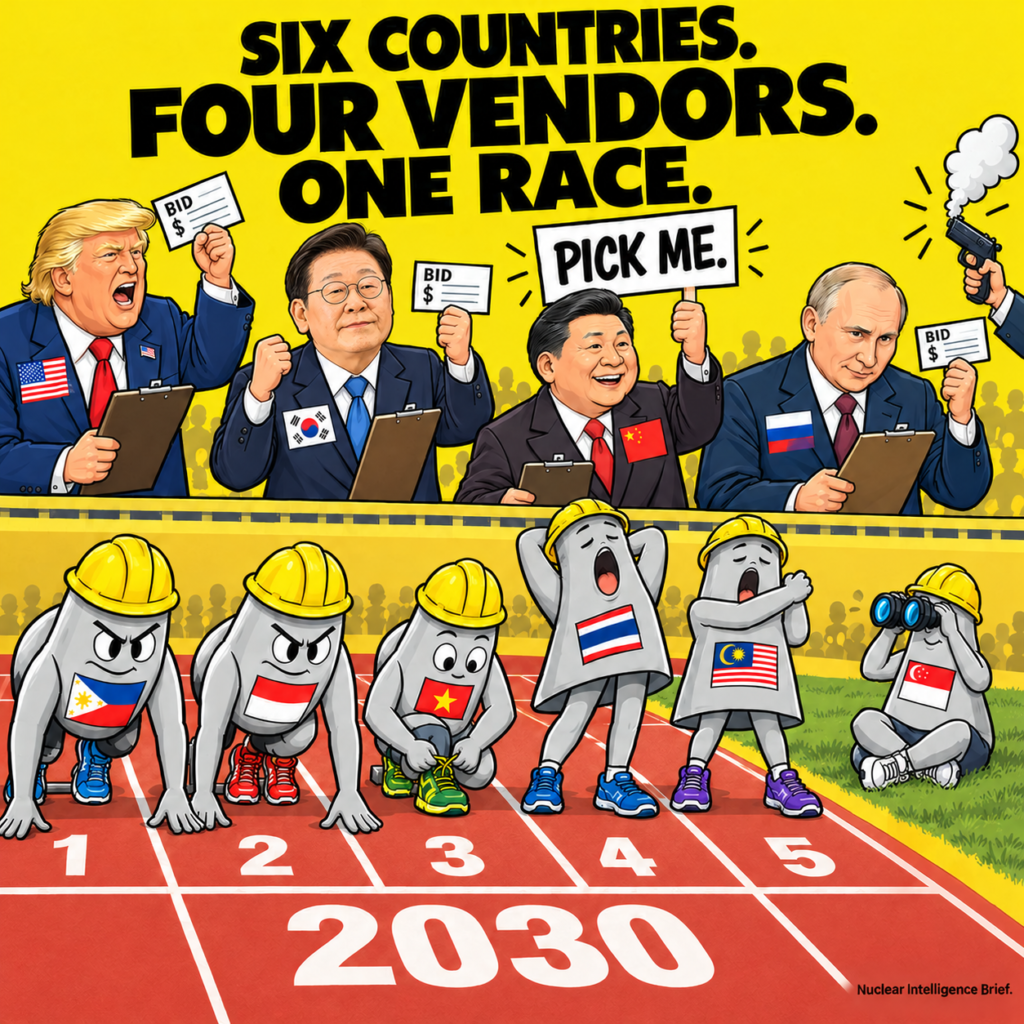
Southeast Asia is emerging as the most contested SMR market outside North America and Europe. Six countries are at different stages of nuclear planning, four external vendors are competing for contracts, and the terms of engagement differ sharply by country.
This article sets out where each market stands and what the competitive landscape looks like.
The Philippines: Furthest Along
The Philippines has moved faster than any ASEAN neighbor to integrate SMRs into long-term energy planning. Under President Ferdinand Marcos Jr., the country has set a target of 1,200 MW of nuclear capacity by 2032, expanding to 4,800 MW by 2050.
The framework behind that target includes a 123 Agreement with the United States, which supports Philippine integration of nuclear power by 2032. Several U.S. agencies are collaborating with their Philippine counterparts: the Department of State, the U.S. Trade and Development Agency, the Department of Energy, the Nuclear Regulatory Commission, and the Department of Commerce. The stated purpose is to strengthen regulatory frameworks, expand commercial partnerships, and build a nuclear workforce.
The most concrete development is the partnership between Manila Electric Company (Meralco) and international suppliers. USTDA will fund a $2.7 million feasibility study for Meralco to assess U.S.-designed SMRs, evaluate technologies, identify viable sites, and produce a high-level implementation roadmap.
In parallel, Meralco has signed a tripartite MOU with Korea Hydro & Nuclear Power and the Export-Import Bank of Korea to explore technical and financial pathways for nuclear assets. That dual-track approach, engaging both U.S. and Korean partners simultaneously, is a pattern worth watching across the region.
Indonesia: Advanced Reactors and a Regulatory Head Start
Indonesia’s 10-year electricity supply plan, RUPTL 2025–2034, formally integrates nuclear energy. The initial target is 500 MW by 2034 through two 250 MW SMR units. The government has identified the Sumatra and Kalimantan grids as primary recipients, since both regions are centers for industrial growth and mining operations requiring reliable baseload power.
The most prominent project in the pipeline is the ThorCon Molten Salt Reactor, a 500 MW floating power plant design. ThorCon received approval for its Site Evaluation Plan from BAPETEN, Indonesia’s nuclear regulator, in August 2025 for a site on Kelasa Island. That regulatory milestone places Indonesia ahead of most of its neighbors on design-specific licensing progress.
Vietnam: Re-Entering After a Decade
Vietnam suspended its nuclear program in 2016. It reintroduced nuclear power into its revised National Power Development Plan 8 in April 2025, targeting 4,000 to 6,400 MW of nuclear capacity between 2030 and 2035.
The state-owned utility EVN and the national oil and gas group Petrovietnam have been designated as the primary investors for the first two nuclear power projects. Designating an oil and gas major as a nuclear investor is unusual, and it reflects how few entities in the region have the balance sheet to carry construction-phase capital costs.
Malaysia and Thailand: Feasibility Stage
Thailand’s Power Development Plan 2024 targets two 300 MW SMRs, totaling 600 MW, with construction beginning in 2032 and commercial operations expected by 2037.
Malaysia is targeting 1.2 GW of SMR capacity by 2035 and remains in advanced feasibility study stages. Both countries are still defining site requirements and regulatory frameworks.
Singapore
Singapore has not committed to a nuclear build. The city-state’s land constraints make conventional siting difficult, and its position is best described as watching. Any Singaporean deployment would likely take the form of imported power or a regional colocation arrangement rather than a domestic reactor.
Where the Commercial Opportunities Sit
Five service categories are opening as these markets move from planning to procurement.
Front-end engineering and design. Governments and utilities need partners to identify sites that meet IAEA safety standards, particularly on seismic stability and environmental impact. This covers geological and hydrological surveys, regulatory advisory work to help agencies such as PhilAtom and BAPETEN develop licensing sequences for advanced designs, and environmental impact assessments tailored to tropical and coastal environments.
Manufacturing and supply chain. The shift from on-site construction to factory-based modular manufacturing creates openings for regional manufacturing partnerships, joint ventures to produce nuclear-grade components (valves, pumps, control systems) inside ASEAN industrial zones, supply chain financing for mid-tier companies supporting the fuel cycle, and logistics work managing the transport of factory-built modules to remote sites by barge or heavy rail.
Workforce development. Workforce capacity is the sector’s most severe bottleneck. International firms can monetize this through control room simulators for operator training, as the U.S. State Department has done in the Philippines, vocational and university partnerships to build nuclear engineering and safety curricula, and expert secondment programs placing experienced personnel as shadow operators during the first decade of plant operation.
Fuel services and waste management. Most SMR designs feature long refueling cycles, but fuel security remains a live concern. HALEU supply chain development is the most immediate need, since several advanced designs depend on it. Waste management consulting, covering deep geological repository planning and intermediate storage, is a second opening. Decommissioning planning, integrated into initial project financing, is a third.
Grid and transmission integration. Not covered in the source material but worth flagging: all six countries face the question of how new capacity connects to existing grids, particularly in archipelagic geographies.
The Competitive Landscape: Four Vendors, Four Models
Vendor competition in Southeast Asia runs along national lines. Each vendor nation offers a different package, and the differences go well beyond technology.
The United States leads with government-to-government frameworks. The FIRST program and the negotiation of 123 Agreements create the diplomatic scaffolding. U.S. vendors position Western-certified technology with decades of operating history behind it. The pitch is regulatory credibility and long-term alignment.
South Korea offers an integrated export model. KHNP combines construction, operation, and state-backed financing through KEXIM. The Barakah project in the UAE gives South Korea a delivery record, and its i-SMR and APR-1000 designs are marketed as on-time and on-budget. The recent MOU with Meralco is an example of how KHNP works directly with private utilities to build what it calls a nuclear ecosystem.
China competes on deployment speed and centralized financing. Indigenous designs such as the Hualong One are already being exported. China’s work on fourth-generation designs, including the Wuwei thorium molten salt reactor, makes it a credible competitor for future advanced SMR contracts. The package is state financing plus fast build cycles.
Russia has the longest operating record in small reactors. Rosatom’s experience derives largely from nuclear icebreaker propulsion, with more than 400 reactor-years accumulated on the icebreaker fleet. Its flagship SMR is the RITM-200, adapted for land-based deployment as the RITM-200N, with the single-unit design finalized in September 2018.
Each vendor model carries a different set of trade-offs. U.S. and Korean offers come with higher costs and longer regulatory timelines, but stronger alignment with Western financing institutions. Chinese and Russian offers come with faster deployment and more flexible financing, but carry geopolitical and supply chain risks that Western utilities and their lenders will need to price.
What the Regional Picture Shows
Southeast Asia is not one market. It is six national decisions being made on different timelines, with different legal frameworks, and with different geopolitical alignments.
The Philippines and Indonesia are furthest along. Vietnam has re-entered with state-backed investors. Thailand and Malaysia are still in feasibility. Singapore is watching.
The vendors competing for these contracts are offering not just reactors but financing structures, regulatory scaffolding, and workforce development. The country that selects a vendor is choosing a long-term relationship, not a product.
We track country-by-country SMR deployment timelines, vendor positioning, and regulatory milestones in the SMR Market Intelligence Report 2027.