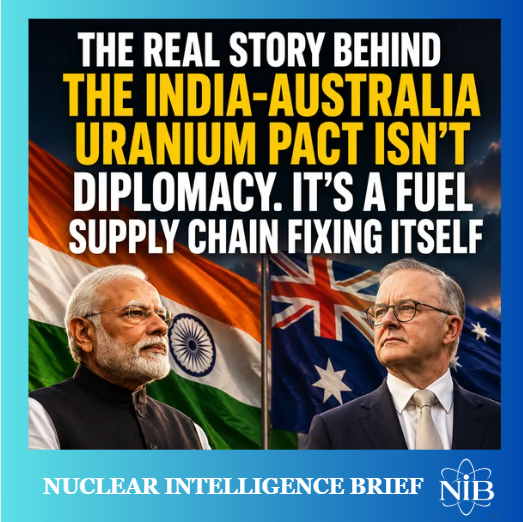
When Prime Minister Modi lands in Melbourne this week for the Australia-India Annual Leaders’ Summit, the headlines will focus on optics: handshakes, a CEOs’ forum, talk of a “landmark” deal. For a business audience, the optics are the least interesting part. The interesting part is what this pact does to the economics of India’s nuclear buildout, and why it’s arriving now rather than a decade ago.
The dependency problem, in numbers
Start with the fact that rarely gets airtime: India has imported 18,842.60 metric tonnes of uranium in various forms between 2008-09 and 2024-25, all under IAEA safeguards, according to a written reply Minister Jitendra Singh gave the Lok Sabha earlier this year. That’s not a rounding error in a resource strategy, it’s the backbone of it. Roughly 70-75% of India’s reactor fuel today comes from abroad, because domestic ore is low-grade, expensive to extract, and geographically scattered across deposits in Jharkhand, Andhra Pradesh, Telangana and elsewhere that mostly test out around 0.05-0.1% uranium content. Domestic production currently runs at roughly 600 tonnes a year, against a demand curve that’s about to steepen sharply.
That’s the number that matters for anyone modelling this sector: annual uranium demand is projected to jump from today’s 1,500-2,000 tonnes to around 5,400 tonnes by 2047, as India chases its target of 100 GW of installed nuclear capacity, up from roughly 8.78 GW today. Domestic mining, even with expansion, is expected to cover only about 30% of that future requirement. The gap is the whole ballgame, and it’s a gap measured in tonnes of a commodity controlled by a handful of countries.
Why Australia, and why now
Australia holds close to a third of the world’s known uranium reserves. India and Australia signed a civil nuclear cooperation framework back in 2014 (it entered into force in 2015), and then sat on it for a decade. Nothing commercial ever moved. The stated reason was always “technical and regulatory” friction around safeguards; the more accurate read is that until recently, India didn’t have urgent enough demand growth, or a clean enough domestic legal framework, to make the deal worth forcing through.
Both of those conditions have now changed. On the demand side, the 100 GW target isn’t just a slogan, it’s a funded roadmap with capacity supposed to reach ~22 GW by 2031-32 through projects already under construction, then another 32 GW by 2047 via NPCIL, with a further 46 GW opened up to public enterprises, state governments, private players and joint ventures. On the legal side, the SHANTI Act, 2025 (Sustainable Harnessing and Advancement of Nuclear Energy for Transforming India), notified in December 2025, replaced the old Atomic Energy Act and Civil Liability for Nuclear Damage Act with a single framework that explicitly opens the door to private-sector participation, including building, owning, and operating plants. That’s the piece most coverage buries, and it’s the piece that actually re-rates the opportunity for corporate India, not just NPCIL.
Seen this way, Melbourne isn’t the start of a relationship. It’s the point where a dormant framework finally gets a commercial reason to activate.
Supplier diversification is the actual strategy
The Australia pact doesn’t stand alone. India closed a long-term supply agreement with Canada’s Cameco earlier this year, roughly 22 million pounds (about 10,000 tonnes) of uranium between 2027 and 2035, valued at approximately C$2.6 billion, and within a month, a separate arrangement with Kazakhstan’s Kazatomprom. Kazakhstan alone has historically supplied close to 80% of India’s imported uranium; Russia’s TVEL has played a specialised role supplying enriched fuel for specific reactor types.
Layer an Australian supply line on top of Canada and Kazakhstan, and the picture is a deliberate hedge: India is spreading procurement across suppliers with different geopolitical risk profiles so that no single relationship, and no single country’s export policy, sanctions regime, or domestic politics, can bottleneck a 100 GW capacity plan. For a business reading this as an input-cost story, that’s the correct frame: this is supply chain de-risking on a commodity where India has structurally weak domestic reserves, not a one-off diplomatic favour.
What this actually changes for capital allocators
For utilities and prospective private nuclear developers, the SHANTI Act plus a diversifying fuel base does two things simultaneously: it lowers long-run fuel-price uncertainty (more suppliers, more competitive terms, less exposure to a single choke point) and it removes the legal ambiguity that kept private capital on the sidelines for over a decade. Six major Indian conglomerates, Tata Power, Reliance, Adani Power, JSW Energy, Jindal Steel & Power and Hindalco, have already responded to NPCIL’s small modular reactor RFP, identifying 16 candidate sites across six states. That’s not speculative interest; that’s balance sheets lining up ahead of a regulatory unlock.
The Australia deal, if it converts from “expected outcome” to a signed commercial contract this week, is best read as a confirmation signal rather than a catalyst in itself. It tells capital that India’s fuel security problem is being actively engineered away, supplier by supplier, which is precisely the kind of derisking that turns a policy target into an investable pipeline.