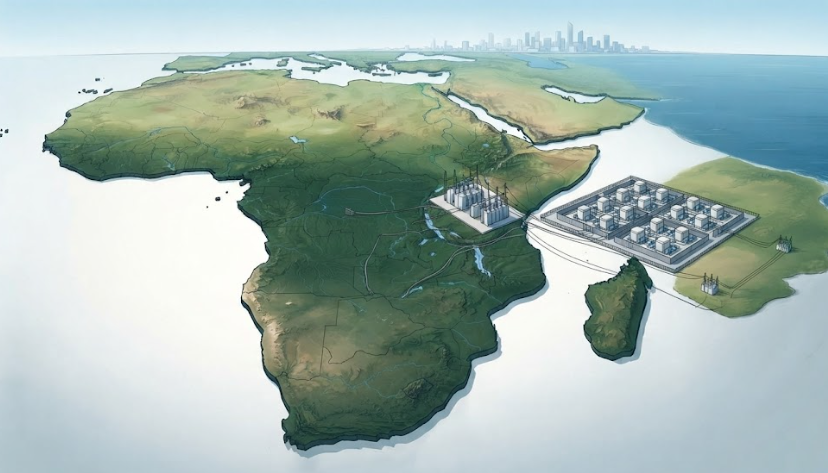
| 2.5-4 GW Projected SMR capacity across Africa by 2035 | $18-32B Total addressable market created by that capacity | 6 Countries with active national SMR pipelines today |
South Africa, Rwanda, Ghana, Kenya, Ethiopia, and Nigeria are all past the policy-statement stage. Morocco is close behind. Contracts are being signed, evaluation panels are being convened, and demonstration plants are being sited, in the first half of 2026. For an industry accustomed to decade-long lead times before a shovel goes into the ground, the pace on this continent is unusual.
A Dual-Track Leader: South Africa
South Africa is running two nuclear strategies at once. IRP 2025, approved by Cabinet in October 2025, commits the country to 5,200 MW of new nuclear capacity by 2039, with the first 1,200 MW online by 2036, inside a R2.2 trillion ($128B) energy strategy. Alongside that large-reactor track, Necsa opened an expression of interest in March 2026 for SMR demonstration partners, and the long-dormant PBMR programme was revived in November 2025, with its intellectual property moved from Eskom to Necsa for research and eventual technology export. Large-scale procurement and modular development are advancing in parallel, which gives vendors two separate doors into the same market.
The Most Competitive Field: Rwanda
Rwanda has become the most technologically open SMR market on the continent. Holtec International has an agreement with the Rwanda Atomic Energy Board for up to 5 GW of SMR-300 units, delivered through Hyundai E&C. Rosatom finalised a separate commercial plant agreement on May 15, 2026, targeting SMR readiness between 2030 and 2032. Dual Fluid Energy and Nano Nuclear are pursuing parallel deals for a demonstration reactor and portable micro-reactors respectively. No other African market currently has this many credible vendors competing for the same customer.
An Industrial Off-Take Model: Ghana
Ghana is targeting 1 GW of nuclear capacity by 2034, built around an industrial power hub rather than a conventional utility model. NuScale Power and Regnum Technology Group, working with Japanese partners, will build the SMRs under an agreement announced in March 2025. The adjacent industrial hub lets local factories draw power and process heat directly from the plant. For any vendor selling process heat rather than just electrons, Ghana is the template worth studying.
Multiple Vendors, One Site: Kenya
Kenya’s Nuclear Power and Energy Agency is evaluating Rosatom, Chinese, US, and PSSECC and Rolls-Royce proposals for a 2,000 MW plant on Lake Victoria, in Siaya County, with construction targeted for 2027 and first power by 2034. A separate research reactor at Konza Technopolis, agreed with Korea’s KAERI in September 2025, runs on its own track. But Siaya County has already seen local opposition to the main site, a reminder that a fully committed national programme can still stall at the community level.
Fastest Mover: Ethiopia
Ethiopia launched a national nuclear programme in September 2025 under a comprehensive agreement with Rosatom, targeting 2,400 MW across two reactors by 2032 to 2034. Choosing a single partner instead of running a competitive bid has let Ethiopia move faster than markets still in evaluation. It is one of the newest entrants to the African nuclear conversation and already one of the most committed on timeline.
Two More Governments Are Already Moving
Nigeria has active nuclear policy development underway, with government statements explicitly naming SMRs as a priority technology pathway. Morocco is at a similar stage, with SMRs identified as part of the country’s future energy mix. Neither has issued formal tenders yet, which means the positioning window in both markets is still open, for now.
What This Means for Vendors and Investors
Three patterns should shape how anyone enters this market.
• Localisation is a prequalification criterion, not a bonus. Technical readiness and financing capacity alone will not clear procurement. A local technology transfer and workforce development plan is expected from the first bid.
• Liability law is uneven. Several newcomer nations have not yet enacted comprehensive nuclear liability legislation. That gap is a form of legal exposure that vendors and financiers need to manage before signing, not after.
• Community opposition can outlast national commitment. Kenya’s experience in Siaya County shows that a government mandate does not guarantee a clear site. Stakeholder engagement has to be budgeted as a core workstream, not treated as a communications afterthought.
Africa Is One Chapter
Africa’s SMR pipeline is one part of a much larger global deployment picture unfolding across 2026 and 2027. The NIB SMR Market Intelligence Report 2027 maps that full picture, country by country, vendor by vendor, for capital allocators who need to make 2027 decisions now.