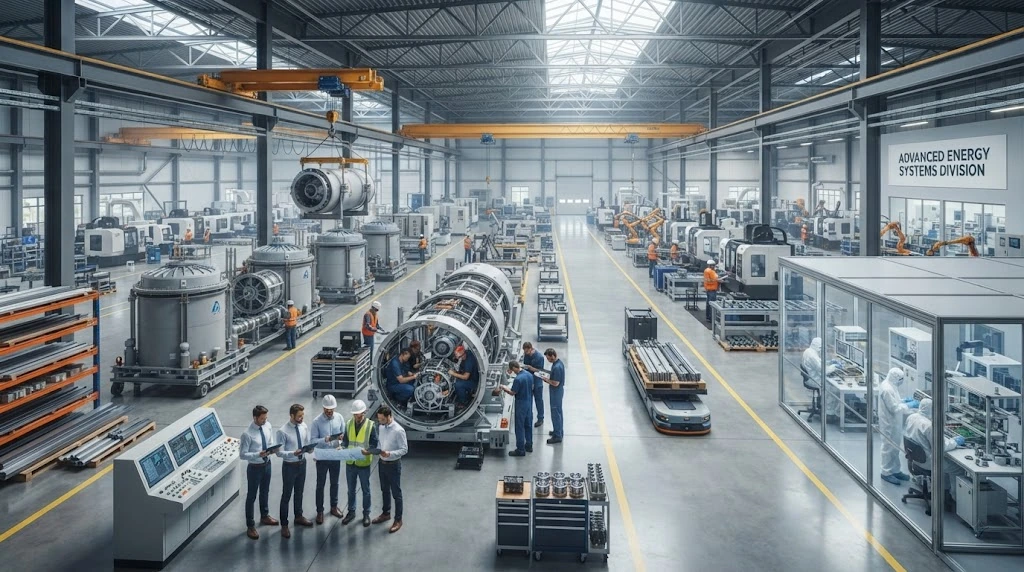
The commercial proposition for small modular reactors (SMRs) is increasingly moving beyond the argument that smaller reactors can be deployed more flexibly than conventional large-scale nuclear plants. The more consequential innovation is the possibility of changing how nuclear facilities are manufactured, financed and constructed. At the center of this model is modularity: deploying reactor units incrementally while manufacturing standardized components in factories and assembling them at project sites.
This represents a significant departure from the traditional nuclear model, which has largely relied on economies of scale. Large reactors concentrate substantial capital in individual projects, with greater generating capacity intended to spread fixed costs across electricity production. SMRs are pursuing a different route. Their economic proposition increasingly depends on economies of series: producing standardized reactor units repeatedly so that manufacturing, construction, labor and financing efficiencies improve with experience.
The success of this model will depend heavily on the development of a credible orderbook. For SMRs, the orderbook is more than an indicator of future sales. A sufficiently large and consistent pipeline could become a core mechanism for reducing costs. Manufacturers need repeat demand to justify factory investment, maintain skilled workforces, develop supplier networks and accumulate manufacturing experience. Developers, meanwhile, need customers willing to adopt standardized designs rather than repeatedly customizing projects for individual markets.
From Construction Site to Factory
Production modularity is the second major component of the SMR business model. Instead of performing most construction activities at the nuclear site, developers can potentially shift a greater proportion of fabrication and assembly into controlled factory environments. Standardized modules can be manufactured away from the site before being transported for final installation.
The potential benefits extend across component costs, labor, quality assurance and construction schedules. Factory production can support repeatable manufacturing processes, common tools and controlled working conditions, potentially improving quality while reducing rework. It can also reduce the workforce required at individual project sites, an increasingly important consideration as nuclear developers compete for specialized labor.
This approach could also help address the workforce constraints associated with large nuclear projects. Conventional reactors can require substantial numbers of skilled workers for many years, often in locations where specialist labor is difficult to obtain. An SMR industry that shifts more activity into factories could concentrate expertise within manufacturing facilities and use repeatable processes across projects.
However, this advantage depends on maintaining a steady development pipeline. A factory cannot sustain specialized capabilities if projects arrive only sporadically. SMR developers therefore need an orderbook capable of supporting a continuous manufacturing cadence.
Construction Time Is a Financing Issue
Modularity also has implications for nuclear project finance. Construction delays do not simply postpone electricity generation; they increase the amount of capital that must be financed before a project begins generating revenue.
Interest during construction (IDC) can therefore become a significant component of total project economics. Assuming a borrowing rate of 5.9% and an 80% debt-to-capital ratio, IDC could add approximately 13% to overnight costs for a four-year project, compared with approximately 31% for a 10-year project.
The precise impact varies according to financing structures and project conditions, but the relationship is clear: shortening construction can reduce the amount of time capital remains exposed to project risk and can limit the accumulation of interest before commercial operations begin.
Factory fabrication could support this schedule compression by allowing activities to occur in parallel. Modules can be manufactured while site preparation proceeds, reducing the volume of sequential construction work required at the project location.
For investors and lenders, the prospect of shorter and more predictable schedules could eventually become as important as the reactor’s generating capacity.
The Learning Curve Is the Real Test
The long-term SMR proposition ultimately depends on whether manufacturing efficiencies can be repeated across multiple units. Estimates cited in the dataset place the potential learning rate for SMRs at 5–10%, compared with approximately 1–5% for large reactors, depending on the degree of modularity, factory fabrication, design standardization, supply-chain consistency and regulatory environment.
These figures do not guarantee that every successive reactor will become 5–10% cheaper. Rather, they illustrate the potential for repeated production to generate faster improvements in productivity and cost than bespoke nuclear construction.
Standardization is therefore critical. If every project requires significant design modifications, different components or different manufacturing processes, the benefits of repetition weaken. The more closely successive units resemble one another, the greater the opportunity for manufacturers to refine production processes and capture efficiencies.
This creates a commercial tension for developers. Customers may want designs adapted to local requirements, while manufacturers need standardization to achieve economies of series. Managing that balance could become one of the industry’s defining challenges.
Advanced Manufacturing Could Extend the Advantage
Production modularity could also accelerate adoption of advanced manufacturing technologies such as electron-beam welding, powder-metallurgy hot isostatic pressing, diode laser cladding and additive manufacturing.
These techniques are established in industries including aerospace but remain more limited in nuclear because of stringent safety, regulatory and material requirements. SMRs could nevertheless provide an important pathway for their adoption because their economics already depend on standardized factory production.
NuScale, Framatome, Westinghouse and Siemens are among companies examining advanced manufacturing applications. NuScale’s program, supported by the U.S. Department of Energy and the UK’s Nuclear Advanced Manufacturing Research Centre, has targeted a 40% reduction in reactor pressure vessel manufacturing costs and a manufacturing time of less than 12 months.
Such targets remain development objectives rather than established industry-wide results, but they demonstrate the direction of travel: transforming nuclear manufacturing from project-specific fabrication toward repeatable industrial production.
The Orderbook Becomes a Strategic Asset
For investors, utilities and policymakers, this makes the structure of the SMR orderbook particularly important. A collection of unrelated projects using different designs offers less manufacturing leverage than a fleet of standardized units based on the same platform.
The orderbook can provide the demand visibility required to justify factory investment, supplier development and workforce retention. It can also enable experience from one project to improve the economics of subsequent units.
Ultimately, SMR competitiveness may depend less on which developer has the most sophisticated reactor design and more on which company can manufacture and deploy that design repeatedly at scale.
The traditional nuclear industry pursued economies of scale. SMRs are betting on economies of series.
If developers can build credible orderbooks, standardize designs and establish repeatable factory production, modularity could become more than an engineering innovation. It could become the foundation of a new nuclear business model.
For SMRs, the orderbook is not merely a measure of future demand. It may be the mechanism that makes the economics work.
To learn more about the business case for SMRs in 2027, download the SMR Market Intelligence Report 2027. It is the industry’s most concise and effortless market forecast guide.