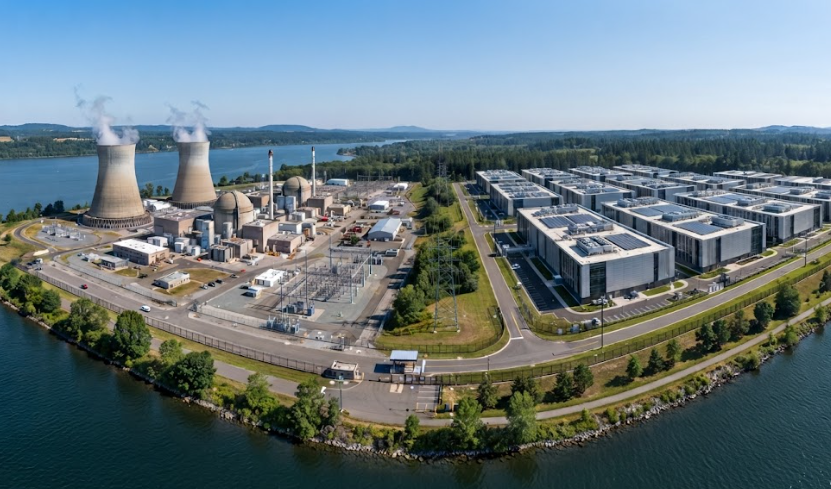
For decades, nuclear power has largely been a utility-led business. Utilities developed reactors, governments supported the regulatory and policy framework, and industrial customers purchased electricity once plants were operating. That model is beginning to change.
Since 2023, some of the world’s largest technology companies have moved increasingly closer to the nuclear sector through long-term power purchase agreements (PPAs), direct investments, development partnerships and commitments to emerging reactor technologies. Microsoft, Google, Amazon, Meta and Walmart are now among the companies securing or supporting nuclear generation in the United States.
The shift is being driven by a straightforward commercial reality: the growth of artificial intelligence and data centers is creating an enormous requirement for reliable electricity. For technology companies operating energy-intensive facilities around the clock, nuclear offers something that intermittent generation cannot easily provide on its own — large volumes of firm, low-carbon power.
But the significance of Big Tech’s involvement extends beyond electricity procurement. These companies are increasingly becoming participants in the development and financing ecosystem itself.
From Power Buyers to Project Partners
The first stage of this transition was the signing of long-term PPAs. Microsoft, for example, agreed in 2024 to purchase power supporting the restart of Three Mile Island Unit 1. Amazon subsequently signed a long-term agreement connected to Talen Energy’s Susquehanna nuclear plant, while Meta agreed in January 2026 to purchase 2,176 MWe from the Perry and Davis-Besse plants in Ohio.
More recently, the technology sector has increasingly moved toward new nuclear projects.
Google signed an agreement with Kairos Power in 2024 to purchase electricity from multiple small modular reactors. Amazon invested $500 million in X-energy, supporting the development of its advanced reactor technology. Meta has gone further, agreeing to fund the deployment of two 345 MWe TerraPower Natrium reactors, with delivery targeted from 2032, while retaining rights to electricity from additional Natrium units.
Meta has also agreed to provide prepayment and funding support for Oklo’s planned 1.2 GWe power campus in Ohio.
The distinction matters. A conventional PPA primarily provides an offtake commitment. Funding and development agreements can provide something more valuable to emerging nuclear projects: demand visibility and capital at an early stage of development.
Nuclear’s New Anchor Customers
For new nuclear technologies, securing an anchor customer can be commercially transformative.
Advanced reactors and SMRs face substantial upfront costs associated with engineering, licensing, manufacturing capacity and first-of-a-kind deployment. Developers must demonstrate not only that their reactor works, but that there will be customers willing to purchase its electricity.
Big Tech can potentially address part of that challenge.
A long-term commitment from a major technology company can provide developers with greater visibility over future revenue and electricity demand. It can also help demonstrate market appetite to other investors, utilities and project partners.
This creates a potential feedback loop: large electricity demand encourages technology companies to secure nuclear supply; those commitments improve project visibility; stronger project visibility can support financing and development; and successful projects can ultimately create additional nuclear capacity for the next wave of demand.
That model could become particularly important for SMRs, where the economics depend heavily on achieving repeat deployments and moving down the manufacturing learning curve.
The Technology Bet Is Broader Than SMRs
Big Tech’s nuclear strategy is also notable because it is not concentrated on a single reactor technology. The companies are pursuing a broad portfolio that includes operating reactors, uprates, SMRs, advanced reactors and fusion.
Microsoft has agreements involving both Helion’s planned fusion facility and existing nuclear generation. Google has backed both Kairos Power’s advanced reactors and Commonwealth Fusion Systems’ planned fusion project. Amazon has committed capital to X-energy while also securing power from existing nuclear generation. Meta is simultaneously supporting existing reactors, TerraPower’s Natrium technology and Oklo’s advanced fission project.
This suggests that Big Tech is not necessarily betting on one particular nuclear design. It is betting on nuclear’s ability to provide reliable electricity at scale. That distinction could prove important as the technology landscape evolves.
AI Is Changing the Value of Firm Power
The expansion of AI infrastructure is adding urgency to the equation. Data centers require substantial and continuous electricity supplies, and their power requirements can remain concentrated around the clock rather than following traditional industrial demand patterns. For technology companies, therefore, electricity availability is increasingly becoming a strategic constraint rather than simply an operating expense.
Nuclear power’s ability to deliver continuous generation gives it a distinctive position in this emerging electricity market.
The commercial implications extend beyond the technology companies themselves. Utilities with existing nuclear fleets could find new opportunities to monetize long-term power contracts. Nuclear developers can gain potential anchor customers for new projects. Equipment manufacturers and EPC companies can benefit from expanding project pipelines, while investors gain exposure to a market increasingly supported by corporate demand.
Walmart’s first nuclear PPA, covering approximately 176 MWe from Constellation’s Dresden plant in Illinois, is another signal that this trend is beginning to extend beyond the largest technology companies.
A New Nuclear Financing Ecosystem
The most important development may therefore be the emergence of a new relationship between nuclear developers and electricity-intensive corporations.
The traditional model was largely government → utility → reactor → electricity customer.
The emerging model could become considerably more interconnected:
technology company → long-term offtake → developer → financing → reactor deployment → dedicated electricity supply.
In some cases, the technology company may also provide direct capital or development support. That could change the bankability conversation around new nuclear. Instead of relying primarily on government support or utility balance sheets to carry early-stage project risk, developers may increasingly be able to combine public policy, private capital and long-term corporate demand.
The model is still developing, and major technical, regulatory and financial challenges remain. Not every announced project will reach construction, and long-term corporate commitments do not eliminate the risks associated with first-of-a-kind nuclear deployment.
But the direction is becoming increasingly clear. Big Tech is no longer simply consuming electricity from the nuclear industry. It is beginning to influence how new nuclear capacity gets financed, developed and brought to market.
As AI-driven electricity demand accelerates, the nuclear industry’s customer base may be changing just as significantly as its reactor technology. And for developers, investors and suppliers positioning for the next nuclear buildout, who is willing to pay for the power may become almost as important as who can build the reactor.
Get your copy of the SMR Market Intelligence Report 2027 Now!