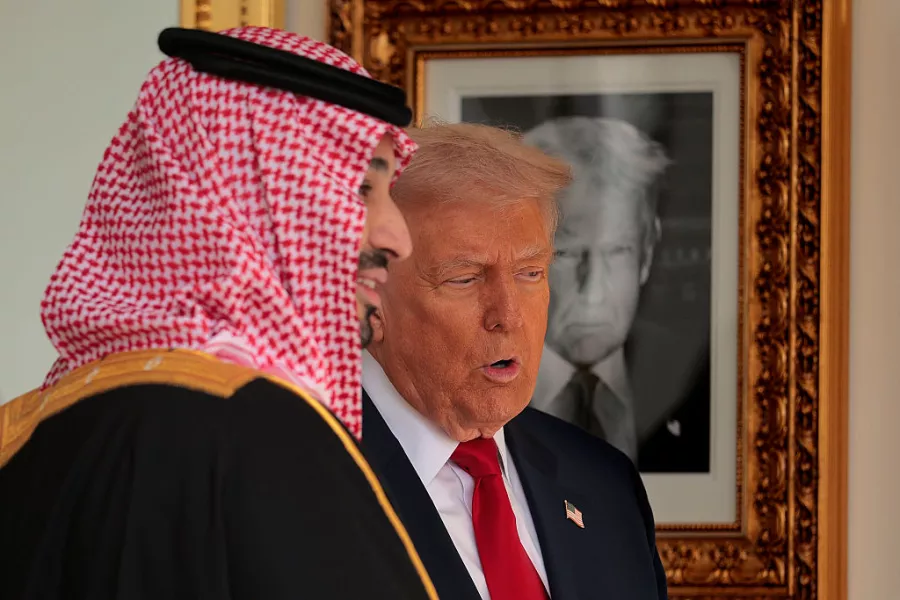
On July 22, 2026, the United States and Saudi Arabia announced a civilian nuclear cooperation deal built on a Section 123 agreement and a bilateral safeguards framework. The US Department of Energy called it historic. Energy Secretary Chris Wright framed it as commerce, prosperity, and security rolled into one. Congress must still review it. But the headline number, a decades-long, multi-billion-dollar partnership, tells the real story: this is not a single power plant deal. It is the opening of a market, and small modular reactors, not gigawatt-scale giants, are where that market will actually be won.
For over a decade, Saudi Arabia’s nuclear ambitions have been defined by scale that never arrived. In 2013, KA-CARE projected 17 GWe of nuclear capacity by 2032. That target quietly moved to 2040, then faded from view. Sixteen reactors over twenty years, once floated at a cost above 80 billion dollars, never broke ground. What did survive, quietly, across a decade of stalled megaprojects, was interest in smaller reactors: South Korea’s SMART design, Argentina’s CAREM, China’s HTR-PM. The kingdom’s Nuclear Holding Company is now moving ahead with two large 1.4 GWe reactors at Duwaiheen, but the pattern is unmistakable. Every time Saudi Arabia’s big nuclear plans stalled, SMRs stayed on the table.
That pattern is now converging with the largest structural need in the Saudi power sector. The kingdom generates 99 percent of its electricity from gas and oil, consumes over 300 TWh a year, and runs a 60 Hz grid that cannot easily interconnect with the rest of the region. Riyadh cannot simply import surplus power from neighbors during demand spikes. It has to build firm capacity domestically, and it has to pair that capacity with desalination, since Saudi Arabia depends on roughly 11 million cubic meters a day of desalinated water. SMRs, unlike large baseload reactors, are built for exactly this combination: distributed siting, cogeneration with desalination plants, and phased capital deployment that does not require a single 20 billion dollar commitment upfront.
This is the business case, stated plainly. A large nuclear plant is a sovereign wealth decision. An SMR fleet is a procurement decision, repeatable, financeable in tranches, and exportable as a template to the rest of the Gulf. For US reactor vendors, that difference matters more than the headline gigawatts.
The 123 agreement changes the competitive picture that has existed since 2013, when GE Hitachi and Toshiba-Westinghouse first signed exploratory deals with KA-CARE, deals that went nowhere because there was no government-to-government cooperation framework behind them. Without a 123 agreement, US firms cannot transfer nuclear technology or fuel to a foreign partner, full stop. That legal gap is exactly why China, Russia, and South Korea filled the vacuum for over a decade of Saudi nuclear planning. The new agreement removes that gap. It does not guarantee US companies win Saudi contracts, but it makes them eligible to compete for the first time in a decade on level legal footing, and Washington has just spent significant diplomatic capital ensuring they compete with government backing.
The prediction worth making here is specific: the near-term contracts will not be the flagship Duwaiheen units, which are already deep into a multi-vendor bid process involving French, Chinese, South Korean, and Russian players. The realistic opening for US SMR developers is the second wave, the desalination-linked, industrial-zone, and NEOM-adjacent capacity that Saudi Arabia has talked about since 2015 and never had a legal pathway to source from the United States. Expect the first US-linked SMR announcements in the kingdom to be framed around water security and industrial decarbonization rather than grid-scale electricity, because that framing survives budget cycles and change of political weather better than pure power generation targets do.
The unresolved variable, and the one investors should watch most closely, is enrichment. US media reporting suggests the deal may allow Saudi Arabia to enrich uranium domestically rather than rely on imported fuel, a provision the Energy Department has not confirmed. If true, this becomes the most contested nuclear nonproliferation question in Washington this year, given that the US and Israel are simultaneously prosecuting a war against Iran explicitly to prevent Iranian enrichment. A Congress that blocks or narrows enrichment rights would still leave SMR technology transfer intact, since most competitive SMR designs are built around low-enriched fuel supplied externally rather than domestic enrichment infrastructure. That is, paradoxically, good news for SMR vendors specifically, even if it becomes bad news for the broader agreement’s political survival.
For US companies positioned in the SMR space, the takeaway is not that Saudi Arabia has opened its checkbook. It is that the legal architecture blocking US participation for a decade has just been dismantled, in a market that has consistently gravitated toward smaller, modular, desalination-linked reactors every time its large-scale ambitions stalled. The gigawatt headlines will go to whoever wins Duwaiheen. The recurring revenue, the multi-decade servicing contracts, and the template that gets replicated across the Gulf will belong to whoever wins the SMR pipeline first.
The next twelve months carry three concrete markers to track. First, Congress’s review period for the 123 agreement, where enrichment language will decide how far US firms can actually go. Second, whether KA-CARE issues any formal SMR tender or feasibility study naming a US vendor, the signal that talk has turned into a procurement track. Third, whether Saudi Arabia extends the same desalination-linked SMR framing to NEOM and its industrial zones, since that is where deployment could move fastest, unencumbered by the politics surrounding the flagship large reactor program. Investors and vendors watching only the headline 123 agreement will miss where the actual contracts get signed.
Grab your copy of the SMR Market Intelligence Report 2027 here. It is the simplest, most concise, and direct playbook made for capital allocators and energy investors