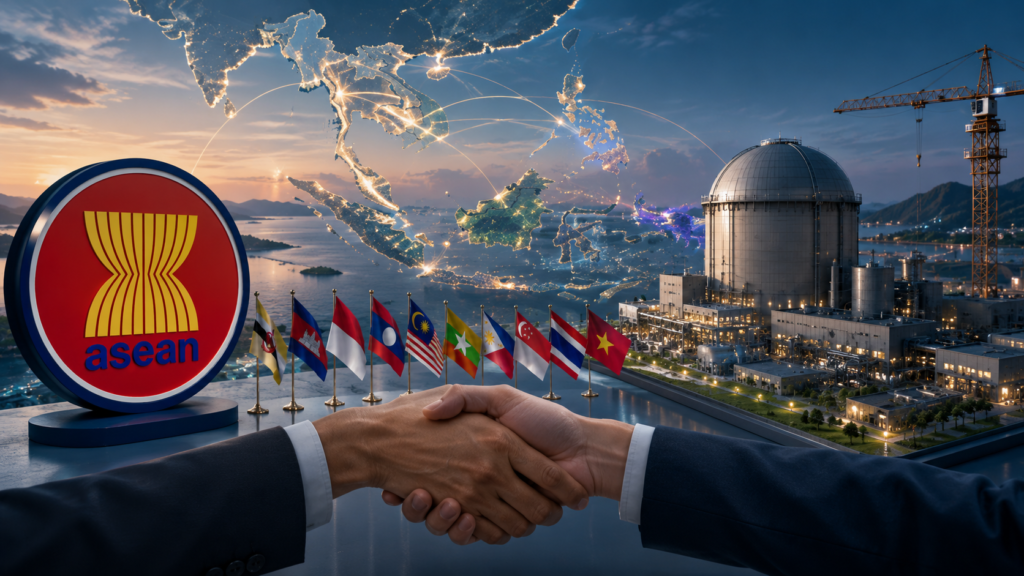
Southeast Asia is no longer a future market for small modular reactors. It is an active one, with capital committed, regulators moving, and vendors already competing for contracts. For companies deciding where to place resources this year, the more useful question is not “which country wants nuclear power” but “which opportunities are close enough to fund today.” This article sorts the ASEAN SMR landscape by deal readiness, then maps the commercial openings and the vendors fighting for them.
Tier One: Capital Is Already Moving
Two markets have crossed from planning into funded activity.
The Philippines leads the region. Manila has set a target of 1,200 MW of nuclear capacity by 2032, rising to 4,800 MW by 2050, backed by a 123 Agreement with the United States and coordinated support from the U.S. Department of State, USTDA, Department of Energy, Nuclear Regulatory Commission, and Department of Commerce. The clearest signal of commercial traction is Meralco’s work with international partners: USTDA is funding a 2.7 million dollar feasibility study to help Meralco evaluate U.S.-designed SMRs, screen sites, and build an implementation roadmap. Meralco has also signed a tripartite MOU with Korea Hydro & Nuclear Power and the Export-Import Bank of Korea to explore financing and technical pathways. This is a market where two vendor camps are already competing for the same buyer.
Indonesia has moved from intent to regulatory approval. Its 2025-2034 electricity supply plan formally includes nuclear power, targeting 500 MW by 2034 through two 250 MW SMR units, aimed at the industrial and mining grids of Sumatra and Kalimantan. The lead project is ThorCon’s 500 MW floating molten salt reactor, which received Site Evaluation Plan approval from BAPETEN in August 2025 for a location on Kelasa Island. A regulatory approval of this kind is a concrete commercial marker, not a policy aspiration.
Tier Two: Policy Committed, Contracts Next
Vietnam re-entered the nuclear conversation after shelving its program in 2016. Its revised Power Development Plan 8, updated in April 2025, targets 4,000 to 6,400 MW of nuclear capacity between 2030 and 2035. State utility EVN and Petrovietnam have been named as lead investors for the first two projects. The policy foundation is in place; what is missing is vendor selection and financing structure, which makes this the market to watch for the next wave of announcements.
Tier Three: Feasibility Under Way
Malaysia, Thailand, and Singapore are still at the study stage, but with defined numbers attached. Thailand’s Power Development Plan 2024 sets a target of two 300 MW SMRs, 600 MW in total, with construction starting in 2032 and operation by 2037. Malaysia has set a target of 1.2 GW of SMR capacity by 2035. These markets are not yet awarding contracts, but they are the ones to track for early positioning, before the competitive field crowds in.
Four Revenue Lines Open Right Now
Regardless of which tier a country sits in, four categories of commercial work are already fundable.
Engineering, licensing, and site work is the most immediate. Governments and utilities need geological and hydrological surveys for site licensing, regulatory advisory to help agencies such as PhilAtom and BAPETEN build licensing sequences for advanced reactors, and environmental impact assessments suited to tropical and coastal sites.
Manufacturing and supply chain development follows close behind, driven by the industry’s shift to factory-built modules. This opens room for regional manufacturing partnerships producing nuclear-grade valves, pumps, and control systems, supply chain financing for mid-tier component makers, and logistics operations to move factory-built modules by barge or heavy rail to remote sites.
Workforce development may be the largest and most persistent gap. Control room simulators, of the kind the U.S. State Department has already supplied to the Philippines, vocational and university partnerships to build nuclear engineering curricula, and secondment of experienced personnel to act as shadow operators during a plant’s first decade of operation are all commercial services with recurring revenue potential.
Fuel and waste services complete the picture. HALEU supply chains will be needed for several advanced SMR designs, and governments will require consulting on deep geological repository plans, interim storage, and decommissioning cost estimates built into initial project financing.
The Vendor Competition Behind Every Deal
Every opportunity above sits inside a larger contest between four national vendor models, each selling more than technology.
United States: operates through government-to-government frameworks, principally the FIRST program and 123 Agreements. GE Vernova and Hitachi are positioning the BWRX-300 on the strength of decades of boiling water reactor experience, alongside NuScale Power.
South Korea: sells an integrated package. KHNP bundles construction, operation, and state-backed financing through KEXIM, pointing to its delivery of the Barakah project in the UAE as proof of execution. Its MOU with Meralco shows it can also partner directly with private utilities rather than only with governments.
China: competes on speed and centralized financing, exporting proven designs such as the Hualong One, and building a longer-term position in Generation IV technology through projects like the Wuwei Thorium MSR.
Russia: brings the only genuinely operational small reactor track record in the world, drawing on Rosatom’s experience with nuclear icebreaker reactors, over 400 reactor-years, that underpins its RITM-200 design, with a land-based single-unit RITM-200N finalized in 2018.
What This Means for Positioning
The ASEAN SMR market rewards speed of entry more than most energy infrastructure plays, because the near-term work, site studies, licensing advisory, simulator sales, is being contracted now, well before any reactor breaks ground. Vendors and service providers that wait for construction contracts will find the Philippines and Indonesia already assigned, and Vietnam’s decision window closing. The companies moving now are the ones setting the terms for the decade of building that follows.
Grab your copy of the SMR Market Intelligence Report 2027 here. It is the simplest, most concise, and direct playbook made for capital allocators and energy investors.