Small modular reactors have moved from concept slides to signed contracts. The question for 2027 is no longer whether SMRs work, but which business model wins the market.
The small modular reactor sector entered 2026 at a genuine inflection point. China’s Linglong One is on track to become the first land-based commercial SMR in operation, and Western developers are no longer competing on paper designs. They are competing on delivery timelines, balance sheets, and offtake contracts.
Industry trackers now count more than 60 active SMR companies across 15 countries. Roughly 32 of them qualify as Tier 1 players, meaning they hold NRC certifications, construction permits, or contracts worth billions of dollars. The rest are still building toward that threshold. This split matters for anyone assessing where to place capital, partnerships, or attention.
The scale of the opportunity is why capital keeps arriving. One recent industry report frames the SMR buildout as a 700 gigawatt, 0.5 to 1.5 trillion dollar industrial transformation over the next two decades. Bank of America has separately sized the broader nuclear opportunity at 10 trillion dollars. Whatever the exact figure, the direction is the same: this is now an infrastructure category, not a research niche.
Three Business Models, Three Bets
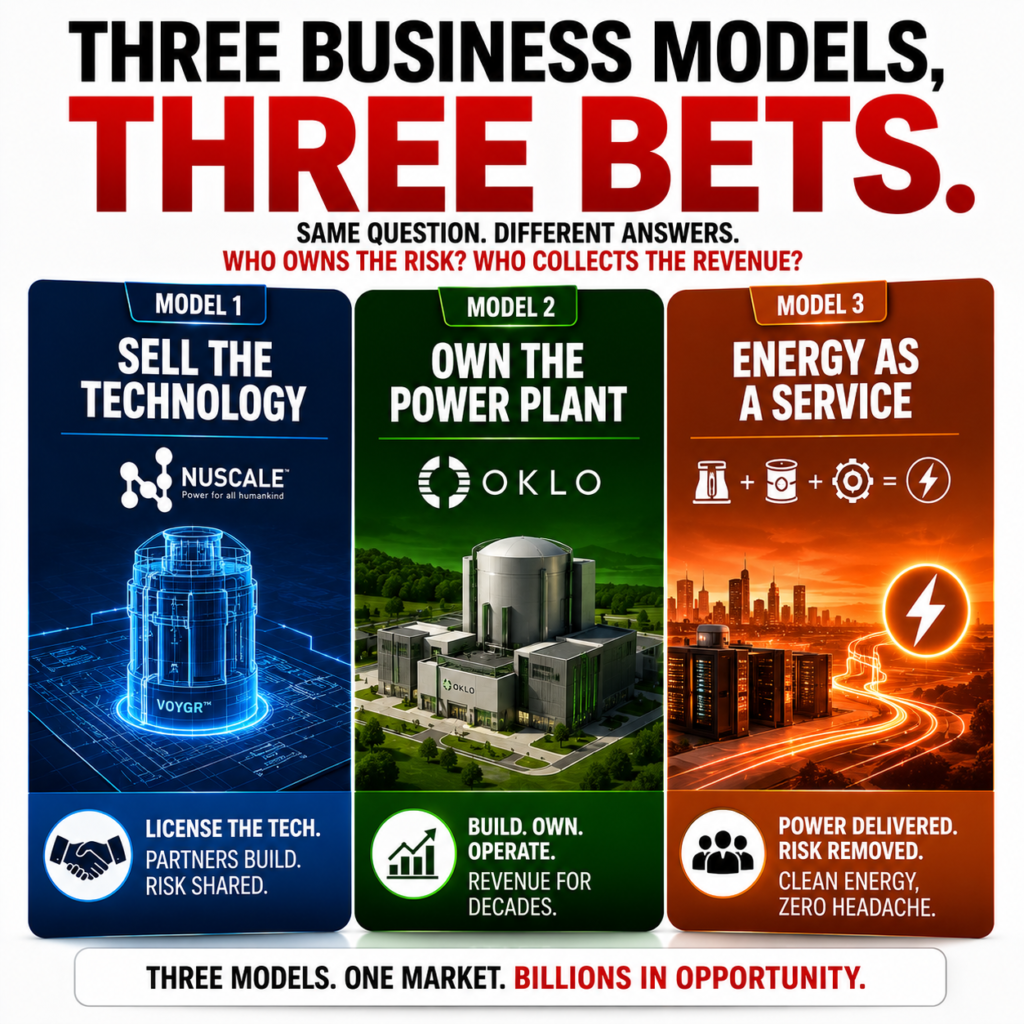
Strip away the reactor physics and the SMR sector is really a contest between three commercial models. Each one answers the same question differently: who owns the risk, and who collects the revenue.
Model one: sell the technology.
NuScale Power represents this approach. It holds the only NRC-certified SMR design in the United States, a genuine first-mover advantage. But NuScale does not want to run power plants. It licenses its VOYGR technology and works through partners such as ENTRA1 Energy to reach utility customers, including a proposed 6 gigawatt program with the Tennessee Valley Authority and a six-module project in Romania. NuScale supplies the engineering. Its partners find the buyers and carry the project risk. Revenue arrives later, but exposure is lighter.
Model two: own the power plant.
Oklo is the clearest example of the opposite bet. Instead of selling reactors, Oklo plans to build, own, and operate its Aurora powerhouses itself, selling electricity directly to customers under long-term contracts. This is the independent power producer model, and it is why Oklo’s pipeline reads more like a utility backlog than a sales funnel, with roughly 14 gigawatts of customer interest anchored by data center operators such as Switch, Equinix, and Meta. The upside is recurring revenue for decades. The downside is that Oklo carries the full capital and execution risk of every plant it builds.
Model three: energy as a service.
A growing group of developers, including several profiled in current market reports, are packaging reactors, fuel, and operations into a single service contract for industrial and data center customers. The customer pays for firm power delivered to the fence line and never takes construction or operating risk. This model is attractive to buyers who want clean, reliable electricity without becoming nuclear operators themselves, and it is becoming the default structure for new data center energy deals.
The Buyers Are Setting the Terms
What changed the sector’s trajectory in the past year is not reactor technology. It is buyer behavior. Hyperscalers are now signing landmark offtake agreements directly with SMR developers: Amazon with X-energy, Google with Kairos Power, Equinix with Oklo. Willingness to pay for firm, carbon-free power has reached 107 to 130 dollars per megawatt-hour in these deals, a level that makes SMR economics workable even before costs fall with volume production.
This buyer-led demand explains why X-energy was able to complete a 1.02 billion dollar IPO in April 2026, upsized and priced above its target range. It also explains why TerraPower has secured more than 2 billion dollars in combined DOE and private funding, and why Holtec is preparing an IPO targeting a valuation above 10 billion dollars. Capital is following contracted demand, not speculative promise.
Fuel and Supply Chain: The Quiet Chokepoint
Reactor developers get the headlines, but fuel supply is where the next bottleneck sits. Most advanced SMR designs need HALEU, a higher-enriched uranium fuel that has only one licensed domestic producer in the United States: Centrus Energy. Centrus has delivered 900 kilograms of HALEU to the Department of Energy and carries a 3.6 billion dollar order book in traditional enrichment services. For any investor or partner evaluating the SMR value chain, fuel supply deserves the same scrutiny as reactor design, because a shortage here caps the entire industry’s delivery speed regardless of how many reactors are certified.
Policy Is Now a Commercial Lever, Not a Backdrop
Governments have moved from funding research to underwriting deployment. The US Department of Energy has fast-tracked ten companies, including Oklo, Terrestrial Energy, and Natura Resources, through a Reactor Pilot Program designed to compress licensing timelines. Sovereign capital is following the same pattern elsewhere: the UK’s National Wealth Fund, the EU’s PINC framework, and dedicated nuclear allocations in Sweden and France are all functioning as commercial de-risking tools rather than grants. Developers that align their project pipelines with these instruments are shortening their path to financial close.
What to Watch Through 2027
- First Western commercial operations: whether NuScale, X-energy, or Kairos convert certified or near-certified designs into operating plants, closing the gap with China’s already-operating fleet.
- Fuel availability: whether HALEU supply expands fast enough to support the licensing pipeline building up behind it.
- Business model convergence: whether the market settles on energy-as-service as the dominant structure for data center deals, or whether ownership models like Oklo’s prove more durable.
- Capital discipline: whether IPOs and sovereign funding keep pace with construction costs, given that first-of-a-kind projects routinely run over budget before costs normalize.
The Strategic Read
The SMR sector in 2026 has stopped being a technology story and become a business model story. The winners will not necessarily be the companies with the most advanced reactor physics. They will be the companies that matched their commercial structure to the right buyer, secured fuel supply early, and used policy instruments to de-risk their first projects. For utilities, hyperscalers, and industrial buyers deciding how to secure power for the next decade, the choice is no longer whether to engage with SMRs. It is which business model fits their appetite for risk and their timeline for power.
Grab your copy of the SMR Market Intelligence Report 2027 here. It is the simplest, most concise, and direct playbook made for capital allocators and energy investors.