The small modular reactor sector is often discussed as a single category, but the technology on offer today spans several distinct engineering paths and commercial propositions. For investors, utilities, and industrial buyers, the differences between these designs are not academic. They determine construction risk, licensing timelines, fuel supply exposure, and the type of revenue a project can generate. A review of six leading SMR designs, BWRX-300, NuScale VOYGR, Rolls-Royce SMR, ACP100, HTR-PM, and LDR-50, shows a market that is still consolidating around a few core approaches, with one clear outlier built for a different purpose entirely.
The Light Water Majority
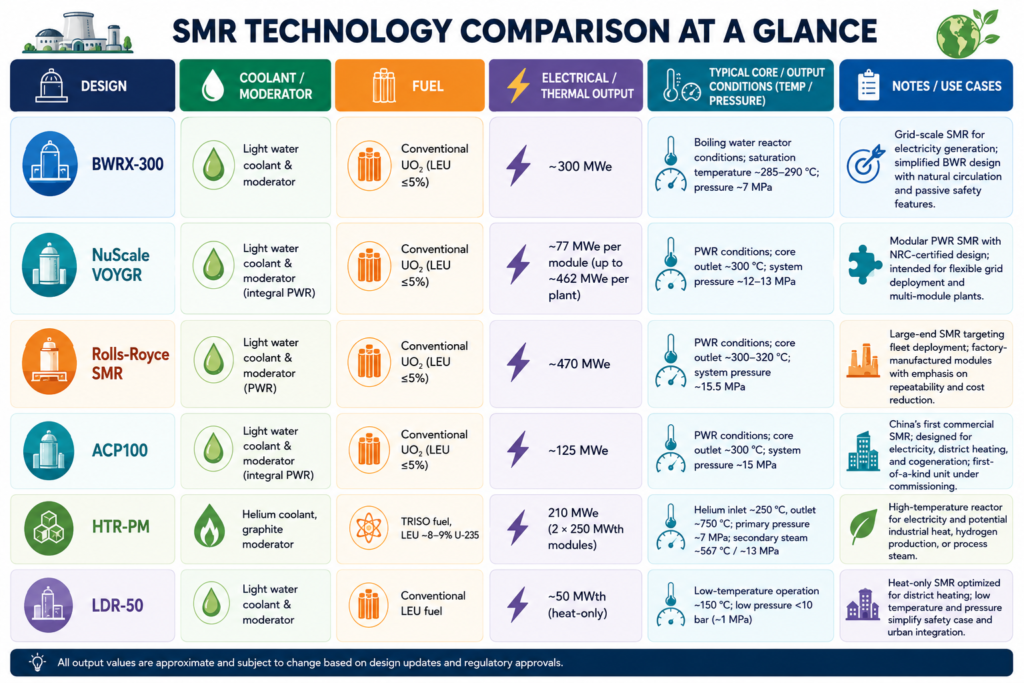
Four of the six designs reviewed here, BWRX-300 from GE Hitachi, NuScale VOYGR, the Rolls-Royce SMR, and ACP100 from CNNC, share the same underlying technology base. All four use light water as both coolant and moderator, and all run on conventional uranium dioxide fuel enriched to five percent or below. This is a deliberate commercial choice as much as an engineering one. Light water reactor technology has decades of operating history, an established fuel supply chain, and a regulatory pathway that licensing authorities already understand. For a developer trying to bring a reactor to market quickly, building on proven light water fundamentals reduces both technical risk and the burden of proof required to satisfy regulators.
Where these four designs differ is in scale and configuration, and those differences map directly to different business models. The BWRX-300 is a boiling water reactor design rated at roughly 300 megawatts electric, positioned as a grid-scale unit that simplifies the traditional BWR by relying on natural circulation and passive safety systems. It is aimed at utilities that want a single unit sized to replace or supplement conventional baseload capacity.
NuScale VOYGR takes a different approach to the same underlying technology. Its integral pressurised water reactor design produces about 77 megawatts electric per module, but the real proposition is the ability to combine modules into a single plant, scaling up to roughly 462 megawatts. This gives buyers a phased investment path, with capital deployed module by module rather than committed to a single large unit upfront. NuScale also holds NRC design certification, a meaningful commercial asset for any buyer concerned about regulatory risk in the United States.
The Rolls-Royce SMR sits at the top end of the SMR scale, rated at approximately 470 megawatts electric using a conventional pressurised water reactor configuration. The design is explicitly built around fleet deployment and factory manufacturing, with an emphasis on repeatable builds to drive down per-unit cost over time. This is a strategy aimed at buyers and governments looking for near gigawatt-scale output without the construction risk profile of a traditional large reactor.
ACP100 represents China’s entry into the same light water category, also using an integral pressurised water reactor design rated at approximately 125 megawatts electric. It is currently being commissioned as China’s first commercial SMR and is designed for more than electricity generation, with district heating and cogeneration included as intended use cases. Its progress will be watched closely as an indicator of how quickly a first-of-a-kind SMR can move from construction to commercial operation.
The High Temperature Outlier
HTR-PM breaks from the light water pattern entirely. Developed in China, it uses helium as a coolant and graphite as a moderator, paired with TRISO fuel enriched to between eight and nine percent, notably higher than the conventional designs above. The plant is configured as two 250 megawatt thermal modules delivering a combined 210 megawatts of output, with helium reaching outlet temperatures of around 750 degrees Celsius on the primary side.
This temperature profile is the design’s core commercial differentiator. Light water reactors cap out at core outlet temperatures around 300 to 320 degrees Celsius, which is sufficient for standard steam turbine electricity generation but of limited use to industry. HTR-PM’s high-temperature helium output opens the door to industrial process heat and hydrogen production, applications that conventional SMRs cannot directly serve. For investors evaluating decarbonization plays tied to heavy industry rather than the power grid, HTR-PM represents a different asset class from the light water group, with a correspondingly different risk profile given its higher enrichment fuel requirement and more limited operating history.
The Heat Only Segment
LDR-50 occupies a category of its own. It is a heat-only design, producing no electricity, rated at approximately 50 megawatts thermal. It uses light water and conventional low-enriched fuel, but operates at a low temperature of around 150 degrees Celsius and low pressure below 10 bar. That modest operating envelope is the entire point. By deliberately limiting temperature and pressure, the design simplifies its safety case and becomes suitable for integration into urban district heating networks, a use case that neither large light-water reactors nor high-temperature designs are well suited to serve. For municipalities and heating utilities looking to decarbonise heat supply rather than electricity, LDR-50 represents a narrower but potentially faster path to deployment given its simpler licensing basis.
What This Means for Buyers and Investors
The practical takeaway for anyone evaluating this space is that SMR is not one product category. The four light water designs compete on the same basic value proposition, proven technology and grid-scale electricity, but differ meaningfully in unit size, modularity, and manufacturing strategy. HTR-PM competes on a different axis entirely, offering access to industrial heat and hydrogen markets that light-water technology cannot reach. LDR-50 competes on yet another axis, prioritising licensing simplicity for a narrow but real heat-only market.
Any serious evaluation should start with the end use rather than the reactor. A utility seeking grid capacity, an industrial buyer needing process heat, and a municipality seeking district heating are not shopping in the same market, even though all three technologies fall under the SMR label. Matching the demand profile to the correct design category, before comparing vendors within that category, remains the first and most consequential decision in any SMR investment or procurement process.