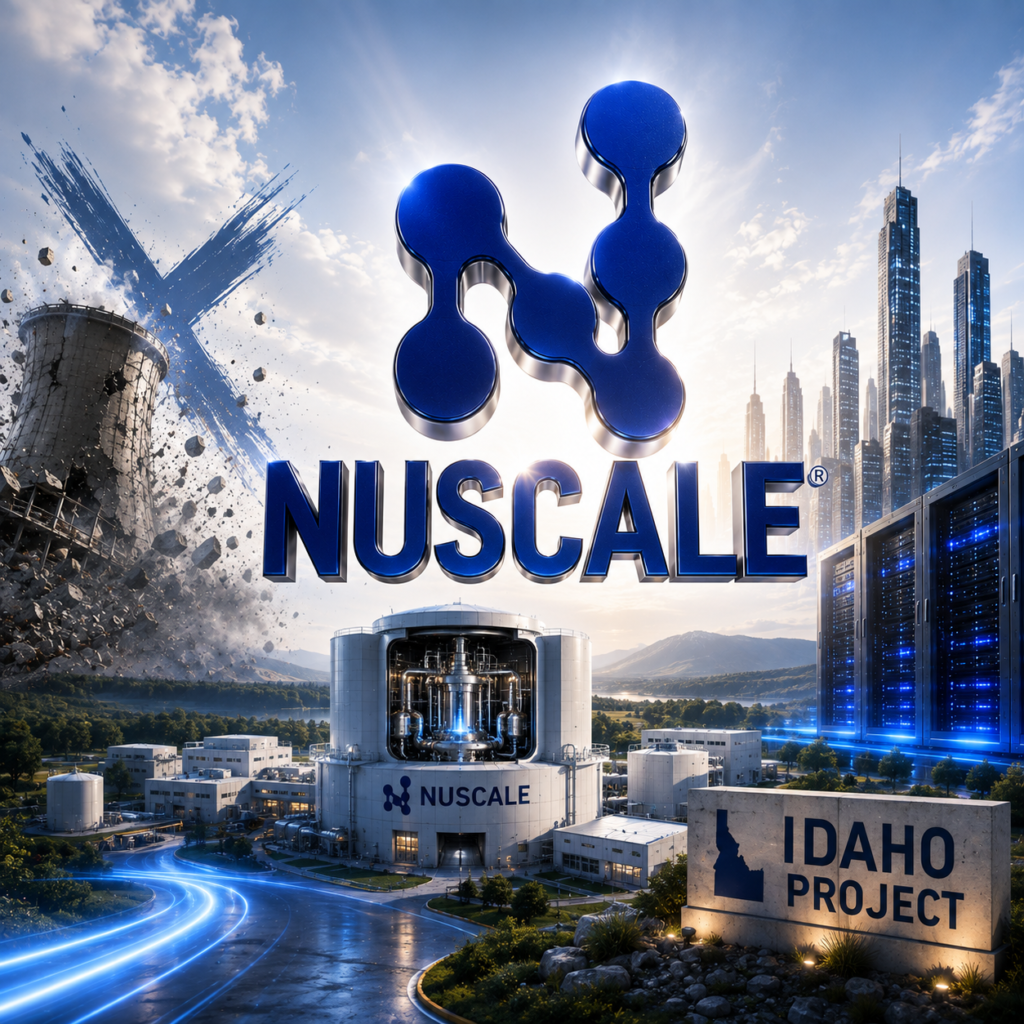
In November 2023, NuScale Power’s stock cratered more than 30% in a single session. The Carbon Free Power Project, six 77-megawatt modules destined for the Idaho National Laboratory site, backed by $232 million in DOE funding and a $1.4 billion cost-share commitment, was dead. Utah Associated Municipal Power Systems and NuScale had run out of subscribers willing to shoulder a price tag that had climbed from $2.8 billion in 2016 to a level the market simply wouldn’t underwrite. For a moment, it looked like the SMR era had been strangled in its crib.
That moment is exactly why business leaders need to understand this story, not as a cautionary tale, but as the opening chapter of a much bigger one.
The Failure That Wasn’t a Failure
Here is what the CFPP collapse actually proved: NuScale’s technology worked. Its NRC design certification, still the only one any SMR developer holds in the United States, was never in question. What killed the Idaho project was financing structure and interest-rate exposure on a first-of-a-kind build, not engineering risk. As one nuclear-safety analyst noted at the time, NuScale remained “one of the designs with the best prospects for commercialization because of its similarity to conventional light-water reactors,” precisely because it isn’t chasing exotic coolants or unproven fuel forms.
That distinction matters enormously to anyone allocating capital in this sector. The CFPP didn’t fail because small modular reactors don’t work. It failed because a single municipal utility consortium tried to carry first-mover risk alone, in a high-rate environment, without the demand certainty that today’s market now provides in abundance.
What’s Different Now
Fast-forward to 2026, and the demand backdrop has been transformed by a force that didn’t meaningfully exist in 2023: hyperscale AI and data-center load growth. Utilities and tech companies are no longer speculatively pre-subscribing to nuclear capacity, they’re competing for it. NuScale entered this year with roughly $1 billion in liquidity, an expanded supply-chain partnership with global nuclear component manufacturer Framatome, and continued progress on a Tennessee Valley Authority program that could support up to 6 GW of deployment through the ENTRA1 platform. The company has also been advancing international work, including the RoPower project in Romania, its first shot at a live construction commitment.
This is the pivot point every serious investor and industrialist should register: NuScale is no longer betting that demand will show up. Demand has shown up. The remaining question is execution, and execution is a solvable business problem in a way that “does anyone want this” never was.
Reading the Market’s Verdict
The equity tape tells its own story. NuScale shares have been volatile through 2026, swinging from the high-$7s to above $14 and back, which is exactly what you’d expect from a pre-revenue, capital-intensive story stock navigating a first-of-a-kind commercialization curve. Wall Street’s institutional read is telling: Truist initiated coverage with a Hold and a $10 target, explicitly citing “strong nuclear tailwinds” alongside execution risk. Barclays, even while trimming its price target, kept an Equal Weight rating rather than walking away. Bank of America restored coverage with a Neutral call rather than a sell. None of this reads as abandonment. It reads as an industry waiting for proof points, proof points NuScale is now positioned to deliver in a way it simply wasn’t in 2023.
For business leaders, that’s the signal, not the noise. Analysts don’t maintain live coverage and price targets on companies they believe are structurally broken. They maintain it on companies where the thesis is intact and the catalysts are dated and visible: quarterly earnings, TVA milestones, RoPower construction decisions.
The Business Case for Getting In Early
Every transformative infrastructure buildout has a phase where the technology is proven but the financing model is still being perfected, and that phase is where the founders’ economics get made. NuScale sits there right now. It holds the only NRC-certified SMR design in America, meaning any competitor pursuing a comparable regulatory pathway is years and hundreds of millions of dollars behind. It has locked in a top-tier industrial partner in Framatome for module manufacturing at scale. And it has a demand environment, AI-driven load growth, corporate decarbonization mandates, energy security politics, that didn’t exist for the Idaho project and isn’t going away.
The CFPP cancellation was not the end of the SMR bet. It was the tuition NuScale, its partners, and the broader industry paid to learn how not to structure first-of-a-kind nuclear finance. The lesson has been absorbed: today’s projects are being built around utility off-takers, sovereign partnerships, and hyperscale power buyers with balance sheets that dwarf a regional municipal consortium’s.
Nuclear power is entering a phase where being early is no longer synonymous with being wrong. The companies, utilities, and investors who study NuScale’s 2023 stumble, rather than simply remembering the headline, are the ones positioned to capture the value in the SMR buildout now unfolding. The bet nearly changed nuclear power once already. The second act is where it does.
Want the Full 2027 Outlook?
This article covers one company’s arc. The bigger question for anyone positioning in this space is where the entire SMR market is headed through 2027: which developers are closest to first commercial power, how policy and financing structures are evolving after CFPP, and where the capital is actually flowing next. The SMR Market Intelligence Report 2027 breaks all of that down in full. If you’re making decisions in this space, it’s worth the download.