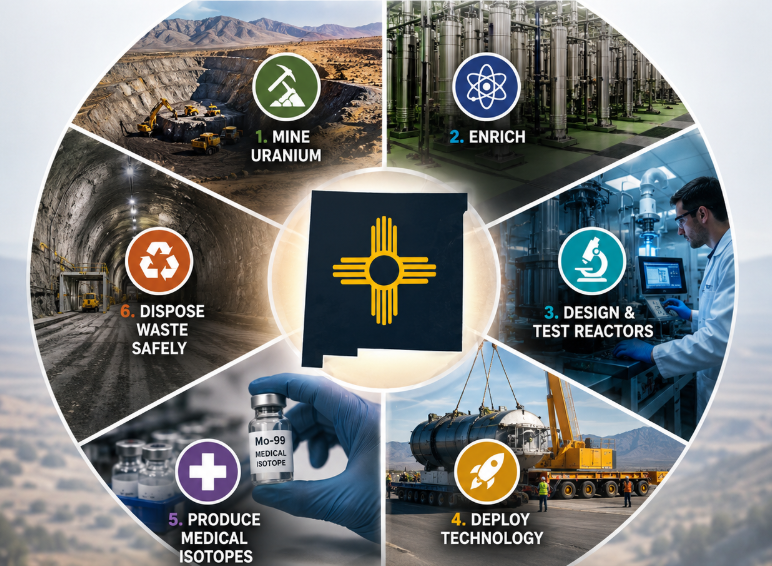
When people talk about the “nuclear renaissance,” they usually mean a reactor design, a policy shift, or a utility’s decision to keep an aging plant online a little longer. New Mexico is a different kind of story. It isn’t one project or one company. It’s an entire vertically integrated nuclear economy, running from raw uranium in the ground to enriched fuel, from weapons science to medical isotopes, from national laboratories to the venture capital now flowing into advanced reactors. Few places on Earth can make that claim, and New Mexico has been building toward it for eight decades.
Where it started
The story begins, as it must, at Los Alamos. Founded in 1943 as the secret “Project Y” of the Manhattan Project, Los Alamos National Laboratory (LANL) assembled the world’s first nuclear device in the New Mexico desert. Sandia National Laboratories grew out of that same effort, formalizing in 1948 and taking on the engineering side of the weapons enterprise. Today Sandia operates as a multibillion-dollar research institution headquartered at Kirtland Air Force Base in Albuquerque, working alongside LANL on everything from stockpile stewardship to next-generation reactor materials.
That history matters not as nostalgia but as infrastructure. Eighty years of sustained federal investment left New Mexico with a density of nuclear expertise, physicists, engineers, health-physics specialists, security professionals, that no other state can match acre for acre.
The full fuel cycle, in one state
What sets New Mexico apart isn’t just the science base; it’s the fact that nearly every stage of the nuclear fuel cycle has a home within its borders.
- Uranium resources: New Mexico sits atop some of the largest uranium reserves in the country, concentrated in the Grants Mineral Belt. A new generation of uranium developers is working to bring domestic production back online after decades of dormancy, reducing US reliance on foreign supply.
- Enrichment: Urenco USA operates the National Enrichment Facility near Eunice, one of the only commercial uranium enrichment plants in the country, and has run for more than a decade without a lost-time accident.
- Waste management: The Waste Isolation Pilot Plant (WIPP), 26 miles outside Carlsbad, is the nation’s only deep geologic repository for defense-related transuranic waste, disposing of material 2,150 feet underground in an ancient salt formation. WIPP recently had its operating permit renewed for another decade.
- Weapons and national security: LANL and Sandia remain central to the multi-decade, multi-hundred-billion-dollar modernization of the US nuclear stockpile, a mission that has added thousands of jobs to the state’s economy.
- Advanced reactors and microreactors: LANL recently achieved criticality on its ZiaCore microreactor, a milestone that signals New Mexico’s ambitions extend well beyond legacy weapons work and into commercial and defense-relevant reactor deployment.
- Space nuclear and medical isotopes: Companies and lab programs in the state are also developing nuclear power systems for space missions and isotopes used in cancer treatment and diagnostics, applications that rarely get mentioned in energy-policy conversations but represent real, growing markets.
Layer onto this a university system (UNM, New Mexico Tech, NMSU) producing nuclear engineers and health physicists, a state government actively courting advanced-energy startups through its Technology and Innovation Office, and a Tribal and rural community stake in uranium legacy and future development, and you get something genuinely rare: a closed-loop nuclear economy operating within a single state’s borders.
Why this matters now
The renewed national interest in nuclear power, driven by AI data-center electricity demand, grid resilience concerns, and a bipartisan push for domestic energy security, has made “cradle to grave” nuclear capability suddenly very valuable. Utilities and investors don’t just want a reactor vendor; they want fuel security, waste-disposal certainty, workforce availability, and a regulatory environment that has decades of practice handling nuclear materials safely. New Mexico can offer all four simultaneously, which is precisely why capital, corporate offices, and policy attention have been migrating toward the state.
This is also why the state’s own advocacy groups have begun explicitly branding New Mexico’s position, not as a nuclear-adjacent state, but as the physical backbone of America’s nuclear enterprise, from scientific discovery to commercialization and deployment.
Where the ecosystem convenes
For anyone tracking this space, investors, utility executives, policymakers, or entrepreneurs building the next generation of nuclear technology, there’s now a single place where the entire New Mexico nuclear ecosystem comes together in one room: the Los Alamos Nuclear Forum, taking place August 25, 2026, at the SALA Event Center in Los Alamos.
Hosted by the New Mexico Nuclear Alliance under the theme “Built in New Mexico. Deployed for the Nation,” the Forum brings together DOE leadership, Los Alamos and Sandia National Laboratories, utility executives, investors, Tribal community leaders, universities, and entrepreneurs for a full day of keynotes, panels, and networking. Speakers include Chris Stanek, Director of Nuclear Energy Programs at LANL, and Eric Skrmetta, Principal Deputy Under Secretary at the Department of Energy, alongside sponsors spanning the Nuclear Energy Institute, Oklo, Westinghouse, Urenco USA, and NANO Nuclear Energy.
If you want to understand where American nuclear energy is actually being built, not just discussed, this is the room to be in.
Learn more and register: Los Alamos Nuclear Forum