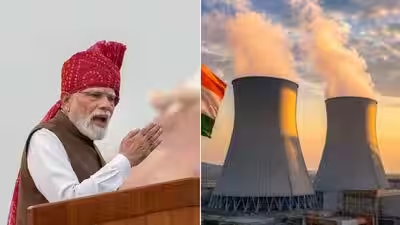
In his 80th Independence Day address from the Red Fort, Prime Minister Narendra Modi outlined a sweeping energy self-reliance roadmap for India, anchored by a newly accelerated nuclear expansion plan. Setting a target of 100 gigawatts (GW) of nuclear power capacity by 2047, the Prime Minister emphasized that the nation’s rapid economic growth and emerging technological demands—specifically driven by artificial intelligence, data centers, and advanced manufacturing—will require unprecedented volumes of firm, uninterrupted baseload power.
Key highlights from the address and the accompanying national roadmap include:
- Near-Term Milestones: The government has committed to operationalizing five new nuclear reactors within the current decade, combining large-scale indigenous pressurized heavy water reactors (PHWRs) with emerging small modular reactor (SMR) designs.
- The Three-Stage Fuel Cycle Pivot: PM Modi highlighted the recent first criticality of the indigenous 500 MWe Prototype Fast Breeder Reactor (PFBR) at Kalpakkam in April 2026 as a monumental leap for India’s nuclear autonomy. The milestone officially bridges the gap to the second stage of India’s nuclear program, laying the groundwork for utilizing the country’s vast domestic thorium reserves in the third stage.
- Structural & Legal Reform: The Prime Minister pointed to the enactment of the SHANTI Act (Sustainable Harnessing and Advancement of Nuclear Energy for Transforming India) and the rolling out of its corresponding regulatory frameworks as vital catalysts. The legislation is specifically structured to streamline licensing, safety oversight, and enable deep private sector participation in what was previously a strictly state-monopolized sector.
Industry Perspective
The official codification of a 100 GW nuclear target by 2047 marks a fundamental shift in how India’s energy planning addresses the trilemma of grid stability, decarbonization, and industrial demand. For decades, India’s nuclear expansion was constrained by strict state-only mandates, capital intensity, and fuel-cycle bottlenecks.
By pairing the legal opening provided by the SHANTI Act with aggressive deployment timelines for both large reactors and indigenous SMRs (such as BARC’s BSMR-200 and SMR-55 designs), the Indian government is attempting to scale a domestic nuclear industrial complex. For the global and domestic nuclear business ecosystem, this creates an unprecedented commercial runway: moving beyond single-plant construction toward a standardized, high-volume manufacturing model capable of supplying carbon-free, high-temperature energy directly to heavy industries and next-generation digital infrastructure.