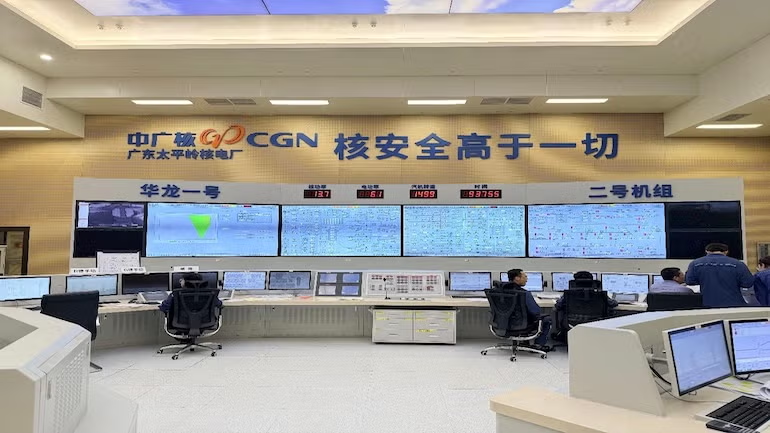
China General Nuclear (CGN) has confirmed that unit 2 of the Taipingling nuclear power plant in Huizhou has successfully delivered its first kilowatt-hour of electricity to the grid. This milestone marks a significant step toward commercial operation for the second unit of the first “Hualong One” nuclear power base located in the Guangdong-Hong Kong-Macao Greater Bay Area.
Following the grid connection, CGN reported that the unit is operating according to design expectations. The reactor will now undergo a series of performance verification tests, with official commercial commissioning currently expected in the second half of 2026. Once operational, the unit is projected to generate over nine billion kilowatt-hours annually, sufficient to meet the power demands of approximately one million residents.
The Taipingling project represents a total investment exceeding CNY 120 billion ($17.7 billion) and is planned to ultimately host six Hualong One units, each with an installed capacity of 1,209 MWe. Upon completion of all six units, the plant is expected to produce more than 55 TWh of electricity per year, significantly impacting regional carbon reduction goals by offsetting 16.65 million tonnes of standard coal consumption and 50.8 million tonnes of CO2 emissions annually.
The construction of unit 2 has been notable for its integration of digital and intelligent technologies. CGN implemented a “smart construction site” framework, utilizing digital handover systems, exoskeleton robotics, and integrated hoisting technology for heavy components. These process innovations, alongside modularization and automated welding, were deployed to improve quality and construction efficiency, setting a technical precedent for future Hualong One projects.
Industry Perspective
The successful grid connection of Taipingling unit 2 serves as a practical case study in the evolution of large-scale nuclear construction. While the global industry is diversifying into modular and niche energy markets, the Taipingling model demonstrates how digital transformation—specifically the application of automated construction systems and real-time project management—can compress delivery timelines for massive, multi-gigawatt facilities. For the broader nuclear business sector, this integration of “Industry 4.0” practices into traditional, large-capacity reactor deployment is increasingly being viewed as a necessary lever for managing capital expenditure and improving site efficiency. As high-growth regions like the Greater Bay Area demand massive, stable power, the ability to replicate this digitized construction playbook will be a defining factor in which developers can achieve large-scale carbon-neutral energy targets on schedule.