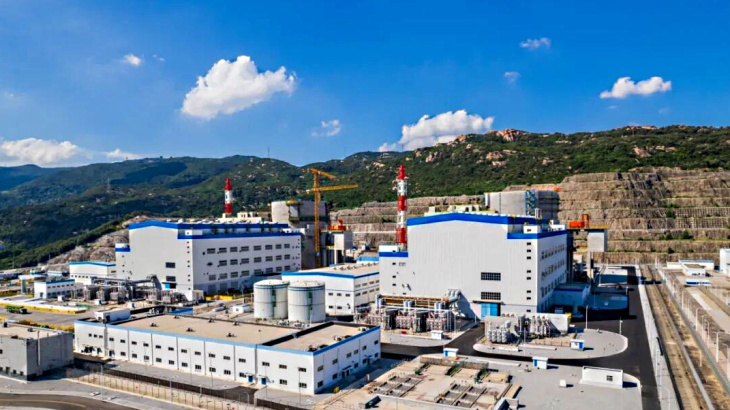
The China National Nuclear Corporation (CNNC) has officially initiated the fuel loading process for unit 7 of the Tianwan nuclear power plant in Jiangsu province. The loading of the first of 163 nuclear fuel assemblies began on August 12, 2026, marking a significant milestone in the commissioning of the facility.
Unit 7 is the first of two Russian-designed VVER-1200 reactors currently under construction at the site. The fuel for this initial loading was supplied by Russia’s Rosatom and manufactured at the Novosibirsk Chemical Concentrates Plant. This development follows the successful completion of “hot tests” in December 2025, which verified system integrity under operational temperature and pressure.
Construction of unit 7 began in May 2021, and its partner, unit 8, commenced construction in February 2022. Both reactors are currently scheduled for commercial operation in 2026 and 2027, respectively. The Tianwan site currently hosts six operational units; upon the completion of units 7 and 8, the total installed capacity of the plant will exceed 9 GWe, with an annual output projection of over 70 TWh.
Industry Perspective
The commissioning of these VVER-1200 units at Tianwan highlights the continued resilience of large-scale, state-backed nuclear expansion models. While the global conversation in the nuclear business sector increasingly focuses on modularity and flexible, smaller-scale designs, these 9 GWe-scale projects represent the high-capacity, base-load bedrock that remains essential for national industrial decarbonization strategies. The smooth progression of these units—from heavy construction to fuel loading—demonstrates that traditional, large-scale deployment models remain a potent mechanism for rapid, high-impact carbon displacement, provided the supply chain remains robust and international technological cooperation is maintained. For stakeholders, this reinforces the viability of conventional large-scale nuclear as a cornerstone for massive industrial power demands.