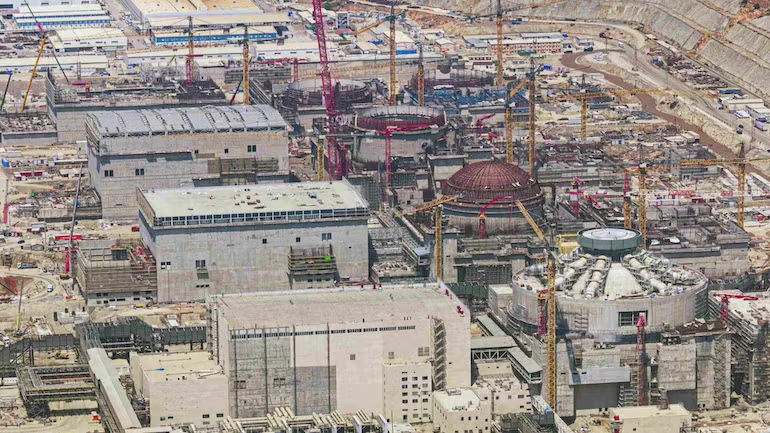
Türkiye’s energy infrastructure is approaching a major threshold as unit 1 of the Akkuyu Nuclear Power Plant enters the final stages of pre-commissioning. Turkish Energy Minister Alparslan Bayraktar confirmed that testing operations are moving forward with the goal of achieving initial test electricity production by the end of 2026.
Recent milestones include a successful trial vacuum build-up operation in the main turbine hall. Conducted over a six-hour window, the procedure tested the steam condenser’s airtight integrity and verified the operational readiness of secondary systems—such as turbine gland seals, lubrication arrays, and thermomechanical monitoring sensors—to ensure the equipment can maintain a deep vacuum before active steam is introduced. These technical procedures follow a series of mandatory pre-start evaluations, including cold hydraulic testing and the integration of the reactor’s passive heat removal systems.
The Akkuyu facility, located on Türkiye’s Mediterranean coast in Mersin province, is being constructed by Russia’s state nuclear corporation Rosatom under a build-own-operate (BOO) model. The multi-unit site is designed to host four Russian-built VVER-1200 pressurized water reactors, bringing a combined capacity of 4,800 MWe to the national grid once fully realized.
Industry Perspective
The progression of Akkuyu Unit 1 toward first power highlights the complex mechanics of executing large-scale nuclear projects under severe geopolitical and supply chain constraints. Delivering a first-of-a-kind multi-gigawatt facility in a new nuclear nation requires navigating immense logistical hurdles, from substitute component procurement to navigating international financial sanctions.
For the broader nuclear business sector, Akkuyu serves as a test case for cross-border export models like Rosatom’s BOO framework. Successfully transitioning this initial unit from construction to active generation will not only reshape Türkiye’s domestic energy independence—shifting away from imported fossil fuels—but also validate how complex nuclear projects can achieve commercial reality despite profound external headwinds.