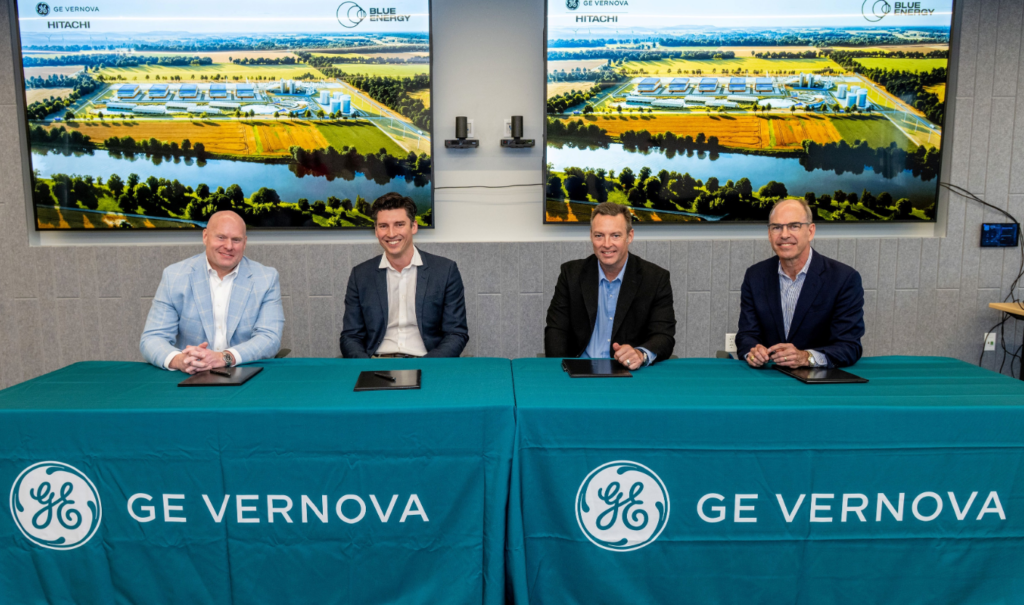
Nuclear project development firm Blue Energy and GE Vernova Hitachi Nuclear Energy (GVH) have signed a formal agreement to advance the next phase of engineering design, licensing, and safety analysis for a major 2.5 gigawatt power facility in Victoria, Texas.
The project introduces a “gas-plus-nuclear” co-location model designed to supply baseload electricity directly to a nearby data center campus and high-density industrial users. Under the current development schedule, the facility will pair two GE Vernova 7HA.02 natural gas turbines—slated for site delivery in 2029 under an existing slot reservation agreement—to provide approximately 1 gigawatt of bridge power starting in 2030. This initial phase is set to be followed by the integration of up to five BWRX-300 small modular reactors (SMRs) from GVH, adding roughly 1.5 gigawatts of nuclear capacity beginning in 2032.
The collaboration utilizes Blue Energy’s “resequenced” construction approach, which has received regulatory support to separate non-nuclear site infrastructure and modular prefabrication from the longer nuclear licensing timeline. This strategy aims to slash traditional deployment schedules to 48 months or less while keeping the project on track toward a definitive final investment decision (FID) targeted for 2027.
The progression of the Victoria, Texas project highlights a pragmatic and increasingly necessary design philosophy in modern energy infrastructure: bridging the gap between immediate power scarcity and long-term clean generation. As explosive growth in artificial intelligence and advanced manufacturing creates unprecedented demand for high-density, reliable power, developers are running up against the realities of grid interconnection bottlenecks and extended nuclear construction timelines.
By utilizing natural gas turbines as an initial bridge that seamlessly transitions into advanced SMR baseload capacity, the gas-plus-nuclear model offers a blueprint for compressing time-to-power. For the broader nuclear business sector, this hybrid architecture effectively de-risks the commercial deployment of third-party SMRs like the BWRX-300. It demonstrates how developers can capture early-revenue streams from energy-hungry tech sectors while establishing the massive, carbon-free infrastructure required for the future energy economy.