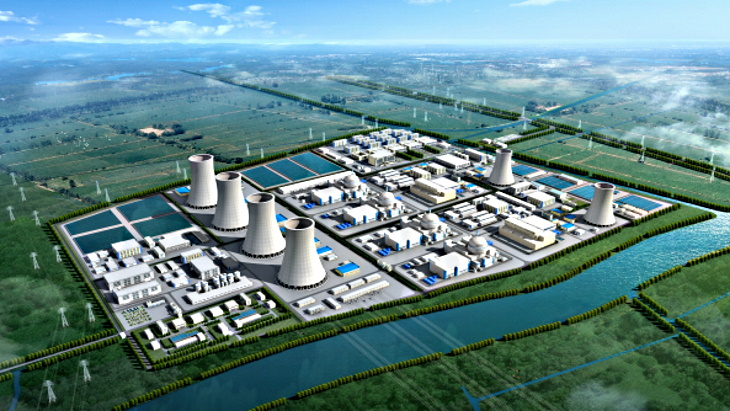
The China National Nuclear Corporation (CNNC) is moving forward with procurement plans for a high-temperature reactor engineering contracting project destined for the first phase of the Xuwei nuclear power plant in Lianyungang, Jiangsu province.
Approved by China’s State Council as part of a batch of 11 new reactors, the Xuwei Phase I development is structured as a dual-coupling demonstration project. The facility will combine two 1,208 MWe Hualong One pressurized water reactors (units 1 and 2) with a single 660 MWe high-temperature gas-cooled reactor (HTGR, unit 3). The project utilizes a specialized steam heat exchange station designed to operate in a dual-heating mode: demineralized water is first heated by the primary steam of the Hualong One units to produce saturated steam, which is then superheated by the primary steam loop of the HTGR.
CNNC subsidiary Suzhou Nuclear Power Company Ltd. is overseeing the procurement process, which is slated for direct execution. Specialized nuclear engineering affiliate CNNC Energy Technology Company Ltd. is set to be entrusted with the design, equipment procurement, delivery, and technical support for the fourth-generation reactor unit. Securing the engineering contract serves as a regulatory prerequisite for pouring the first concrete for unit 3, a milestone targeted for the end of 2026.
Once fully completed, the Xuwei facility is projected to supply 32.5 million tonnes of industrial steam annually alongside a maximum generation capacity exceeding 11.5 billion kilowatt-hours, displacing an estimated 7.26 million tonnes of standard coal usage per year.
The progression of the Xuwei project highlights a critical evolution in how major nuclear developers are designing facilities for industrial integration. By engineering a dual-coupling architecture that weds third-generation pressurized water reactors with a fourth-generation high-temperature gas-cooled reactor, CNNC is directly targeting the massive energy demands of heavy manufacturing and chemical processing. For the broader nuclear business sector, this transition from grid-exclusive power generation to dedicated, high-temperature industrial steam supply demonstrates a scalable pathway for decarbonizing energy-intensive sectors, proving that advanced nuclear design can be customized to function as an indispensable utility asset for heavy industry.